
Fan Selection Guide
How to Choose the Right Cooling Fan for Your Application
Cooling fans are critical components in electronic systems, aerospace equipment, radar units, and industrial devices. Proper fan selection directly affects system reliability, thermal stability, noise level, and service life.
This guide outlines the key engineering factors to consider when selecting a cooling fan.
1. Define the Application Requirements
Before selecting a fan, clearly define the operating conditions:
-
Application type: electronics cooling, radar systems, airborne equipment, naval systems, industrial control, etc.
-
Installation environment: ground, vehicle-mounted, airborne, or marine
-
Operating temperature range
-
Humidity, salt spray, dust, vibration, and shock requirements
-
Continuous or intermittent operation
These factors determine not only fan type, but also material selection, bearing structure, and environmental protection level.
2. Select the Appropriate Fan Type
Different cooling requirements call for different fan structures:
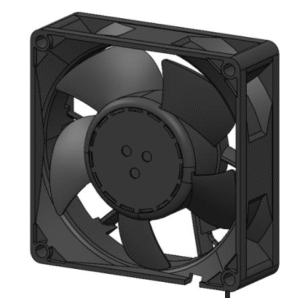
● DC Axial Flow Fans
-
High airflow at low system resistance
-
Compact size, high efficiency
-
Ideal for electronic enclosures, avionics, and control cabinets
● DC Blower (Centrifugal) Fans
-
Higher static pressure
-
Suitable for ducted airflow or compact internal channels
-
Common in dense electronic modules and localized cooling
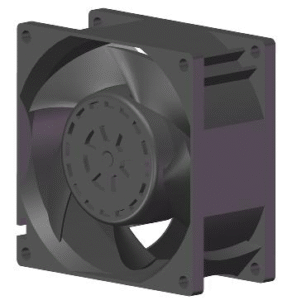
● AC Axial Flow Fans
-
Stable operation in industrial environments
-
Suitable for equipment with AC power supply and continuous operation
3. Determine Key Performance Parameters
The following parameters must be calculated or confirmed:
-
Airflow (CFM / m³/h) – required heat dissipation capacity
-
Static pressure (Pa) – system airflow resistance
-
Rated voltage – 5V / 12V / 24V / 28V / 48V
-
Speed (RPM) – adjustable if supported
-
Noise level (dBA) – especially critical for airborne or indoor systems
-
Power consumption (W)
Important: Maximum airflow alone does not guarantee optimal cooling.
The correct operating point must be determined using the P–Q curve and system resistance.
4. Understand the P–Q Curve (Airflow vs. Static Pressure)
The fan P–Q curve represents the relationship between airflow and static pressure.
-
The intersection point between the fan P–Q curve and the system resistance curve is the actual working point.
-
Selecting a fan solely based on maximum airflow or pressure may result in inefficient cooling or excessive noise.
Proper selection ensures:
-
Stable airflow
-
Lower noise
-
Higher system reliability
5. Environmental Adaptability Considerations
For demanding applications, environmental performance is critical:
-
Temperature resistance (high / low)
-
Salt spray and corrosion resistance
-
Humidity and mold resistance
-
Vibration and shock resistance
-
Electromagnetic compatibility (EMC)
Military-grade and aerospace applications require fans designed and tested according to relevant standards.
6. Signal and Control Function Options
Depending on system requirements, fans may support:
-
FG (Speed Feedback)
-
RD (Rotation Detection / Fault Alarm)
-
PWM Speed Control
-
Voltage Control (VC)
These functions enable intelligent system monitoring and precise thermal control.
7. Reliability and Service Life
Key factors affecting fan lifespan:
-
Bearing type (dual ball bearing recommended for harsh environments)
-
Internal protection (reverse polarity, locked-rotor protection, auto-restart)
-
Continuous aging and reliability testing
High-end applications prioritize long-term stability over peak performance.
Conclusion
Selecting the right cooling fan is an engineering decision—not a simple catalog choice.
A well-matched fan improves system performance, reduces failure risk, and extends service life.
For mission-critical or demanding environments, professional fan selection and validation are essential.