How to Select the Right Cooling Fan for Industrial Control Cabinets
Industrial control cabinets contain electronic components that generate heat during operation. Without proper airflow and cooling design, excessive temperature can reduce system reliability, shorten component life, and even cause equipment failure.
Selecting the right cooling fan is therefore a critical step in the thermal management of control cabinets.
This article explains the key factors engineers should consider when choosing a cooling fan for industrial control cabinets.
1. Determine the Required Airflow
The first step in selecting a cabinet cooling fan is calculating the required airflow.
Airflow is typically measured in m³/h (cubic meters per hour) or CFM (cubic feet per minute).
The required airflow depends on:
-
Heat generated by electronic components
-
Internal cabinet volume
-
Ambient temperature
-
Maximum allowable temperature rise
A simplified airflow estimation formula is often used during early design stages:
Required Airflow ≈ Heat Load / (Air Density × Specific Heat × Temperature Rise)
Proper airflow ensures that heat is continuously removed from the enclosure.
2. Consider Static Pressure Requirements
Many engineers focus only on airflow, but static pressure is equally important.
In real systems, airflow encounters resistance caused by:
-
Air filters
-
Grilles
-
Cable routing
-
Internal components
Fans with higher static pressure capability maintain airflow even when resistance increases.
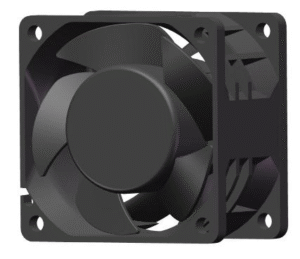
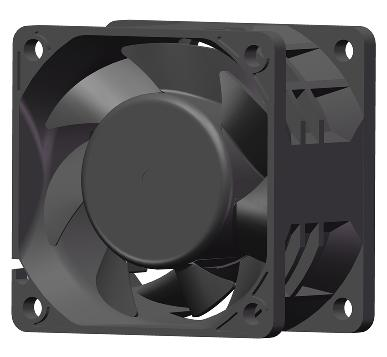
For control cabinets with filters or dense internal components, selecting a high static pressure axial fan is recommended.
3. Evaluate the Installation Space
Industrial control cabinets often have limited installation space.
Common fan sizes include:
-
60 mm
-
80 mm
-
92 mm
-
120 mm
-
172 mm
Engineers must balance available space, airflow requirements, and noise limits when selecting the appropriate fan size.
Compact systems may require smaller fans operating at higher speeds, while larger cabinets can accommodate larger fans with higher airflow and lower noise.
4. Select the Appropriate Bearing System
Fan bearings directly affect service life and reliability.
Two common bearing types are:
Sleeve Bearing
-
Lower cost
-
Suitable for light-duty applications
-
Shorter service life
Dual Ball Bearing
-
Longer service life
-
Better high-temperature performance
-
Higher reliability for industrial equipment
For industrial control cabinets operating continuously, dual ball bearing fans are usually recommended.
5. Environmental Conditions
Industrial environments can expose equipment to harsh conditions such as:
-
High temperature
-
Dust
-
Vibration
-
Humidity
Therefore, the cooling fan should have:
-
Wide operating temperature range
-
Durable structural materials
-
Reliable bearings
-
Stable electrical performance
In demanding environments such as communication equipment, automation systems, and military electronics, reliability is especially important.
6. Noise and Energy Efficiency
Noise may not be critical in some industrial environments, but in control rooms or indoor installations it becomes important.
Fan noise is influenced by:
-
Speed
-
Blade design
-
Bearing type
-
Airflow resistance
Selecting an optimized fan model can provide a balance between airflow performance and acoustic comfort.
Conclusion
Selecting the right cooling fan for an industrial control cabinet requires evaluating several key parameters:
-
Airflow requirements
-
Static pressure capability
-
Installation space
-
Bearing type
-
Environmental conditions
-
Noise considerations
A well-designed cooling solution improves system reliability, extends component life, and ensures stable equipment operation.
When designing thermal management systems for industrial electronics, engineers should consider both fan performance and long-term reliability.