Airflow Is Not Enough: Why Static Pressure Matters in Industrial Cooling Systems
When engineers select a cooling fan, the first specification they often look at is airflow.
200 CFM.
250 CFM.
300 CFM.
At first glance, choosing the fan with the highest airflow appears to be the safest decision.
Unfortunately, real industrial systems rarely operate under free-air conditions.
Control cabinets contain filters, cable bundles, power supplies, heat sinks and protective grilles. Telecom enclosures include dust screens and airflow channels. Outdoor electronics often rely on sealed compartments with limited ventilation paths.
In these environments, airflow alone does not determine cooling performance.
Static pressure does.
A fan that delivers impressive airflow in open air may struggle once installed inside a real enclosure. Conversely, a fan with lower free-air airflow but stronger static pressure capability may provide significantly better cooling performance in actual operation.
Understanding this difference is essential for building reliable thermal management systems.
Understanding Airflow and Static Pressure
Airflow describes how much air a fan can move over time.
Typical units include:
- CFM (Cubic Feet per Minute)
- m³/h (Cubic Metres per Hour)
Static pressure measures the fan’s ability to overcome resistance within the airflow path.
Typical units include:
- Pascal (Pa)
- Millimetres of water column (mmH₂O)
An easy way to understand the difference is to imagine water flowing through a pipe.
Airflow represents the amount of water flowing through the pipe.
Static pressure represents the pump’s ability to push water through restrictions.
Industrial cooling systems behave in exactly the same way.
Why Industrial Equipment Creates Airflow Resistance
Most industrial equipment contains multiple sources of pressure loss, including:
- Dust filters
- Protective grilles
- Dense heat sinks
- Cable routing
- Power modules
- Internal partitions
- EMI shielding structures
Each component adds resistance to airflow.
Individually, the impact may appear small.
Combined together, these restrictions can significantly reduce actual airflow inside the equipment.
In many installations, real airflow can be reduced by more than 50% compared with free-air conditions.
This is one of the main reasons why cooling systems that perform well during testing may struggle once deployed in the field.
The Difference Between Free-Air Performance and Installed Performance
Every cooling fan has a performance curve, commonly known as a P-Q curve.
The curve describes the relationship between airflow and static pressure.
Maximum airflow occurs at zero pressure.
Maximum pressure occurs at zero airflow.
Actual operating conditions exist somewhere between these two extremes.
The point where the system resistance curve intersects the fan curve determines the real operating airflow.
Consider the following example:
| Fan Model | Free-Air Airflow | Maximum Static Pressure |
|---|---|---|
| Fan A | 240 CFM | 55 Pa |
| Fan B | 210 CFM | 110 Pa |
At first glance, Fan A appears to be the better option.
However, if the installed system creates 70 Pa of resistance, Fan A may deliver very little usable airflow while Fan B continues operating efficiently.
In practice, Fan B may achieve lower component temperatures despite its lower airflow specification.
Applications Where Static Pressure Becomes Critical
Control Cabinet Cooling
Modern control cabinets frequently contain:
- PLCs
- VFDs
- Power supplies
- Communication modules
- Heat sinks
High static pressure fans help maintain airflow through these restrictions.
Outdoor Telecom Cabinets
Outdoor telecom systems rely heavily on air filters to prevent dust ingress.
As filters become contaminated over time, airflow resistance increases.
Fans with higher pressure capability maintain stable cooling performance for longer service intervals.
Energy Storage Systems
Battery energy storage systems and power conversion equipment generate significant heat inside compact spaces.
Airflow must pass through densely packed modules and protection barriers.
Static pressure becomes a critical design factor.
Radar and Outdoor Electronics
Radar shelters and outdoor electronic systems often operate with multiple filtration stages.
Without sufficient pressure reserve, airflow decreases rapidly as filters age.
How to Select the Right Fan
When evaluating cooling fans for industrial applications, engineers should consider:
1. System Pressure Loss
Estimate pressure losses introduced by filters, heat sinks, grilles and airflow channels.
2. Actual Operating Point
Avoid selecting fans based solely on free-air airflow specifications.
Review fan performance curves to identify realistic operating conditions.
3. Environmental Conditions
Dust accumulation increases resistance over time.
Selecting additional pressure margin improves long-term reliability.
4. Speed Control Capability
PWM speed control allows airflow to increase automatically as thermal demand rises or filters become contaminated.
5. Reliability Requirements
Applications operating continuously should prioritise:
- Dual ball bearings
- Wide operating temperature capability
- Stable long-term performance
Example: SH-IND Series Industrial Axial Fans
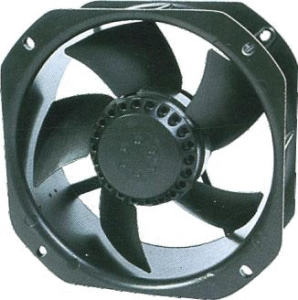
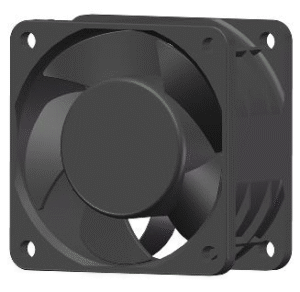
For demanding industrial applications, SenharFans offers brushless DC axial fans designed to balance airflow and static pressure performance.
Typical characteristics include:
- High airflow performance
- Strong static pressure capability
- Dual ball bearings
- Wide operating temperature range
- Optional PWM speed control
- Optional tachometer output
- IP-rated protection options
These features make them suitable for industrial automation, telecom equipment, energy storage systems and outdoor electronics.
Conclusion
Airflow remains an important specification, but it is only part of the thermal design equation.
For systems containing filters, heat sinks and airflow restrictions, static pressure often determines whether electronics remain cool or overheat.
The next time you compare cooling fans, don’t ask only:
“How much air can this fan move?”
Ask instead:
“How much air can this fan move inside my system?”
That question often makes the difference between reliable operation and unexpected downtime.
Contact SenharFans
Planning a new cooling system or upgrading an existing enclosure?
Our engineering team can help you select the right airflow solution for your application.
📩 sales@senharfans.com
🌐 senharfans.com
SenharFans — Reliable Airflow for Demanding Environments.