12038B DC Axial Fan: High Static Pressure Cooling for High-Resistance Systems
12038B DC Axial Flow Fan
In high-density electronic equipment, cooling performance depends not only on the volume of air a fan can move, but also on its ability to overcome airflow resistance within the system.
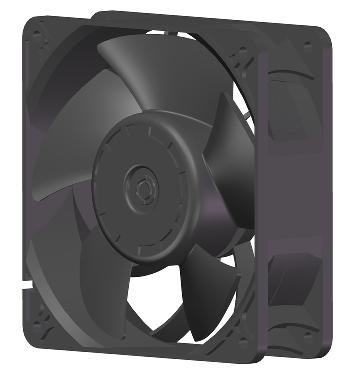
The SenharFans 12038B DC Axial Flow Fan is designed for demanding cooling applications requiring high airflow and strong static pressure. With dimensions of 120 × 120 × 38 mm, an engineering plastic frame and impeller, and a dual ball bearing structure, this model offers multiple speed and voltage configurations for industrial and specialized electronic equipment.
With rated speeds ranging from 6,000 to 11,000 RPM, the 12038B series provides airflow ratings up to 513.9 m³/h and static pressure ratings up to 1,010 Pa, depending on the selected configuration.
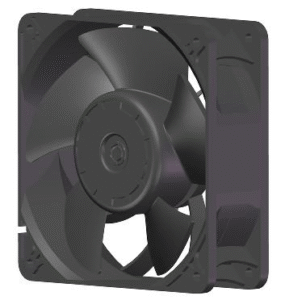
1. Structural Design and Materials
The 12038B uses an engineering plastic frame and impeller, combined with a dual ball bearing structure.
Its main specifications include:
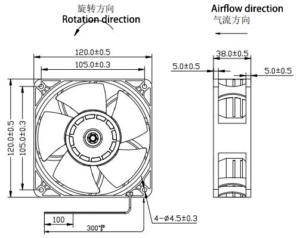
- Dimensions: 120 × 120 × 38 mm
- Frame material: Engineering plastic
- Impeller material: Engineering plastic
- Bearing type: Dual ball bearings
- Weight: 335 g
The 120 mm × 38 mm form factor provides a larger installation depth than standard 120 mm × 25 mm fans, allowing different blade and motor configurations to be accommodated.
For OEM equipment design, engineers should also consider mounting space, airflow direction, electrical connections, vibration requirements, and the fan’s operating environment.
2. Performance Specifications: High Airflow and Static Pressure
The 12038B series offers several performance configurations across 12V, 24V, 28V, and 48V platforms.
The following table summarizes the published rated performance data.
12038B DC Axial Fan Performance Table
| Model | Voltage | Speed | Airflow | Static Pressure | Noise | Power |
|---|---|---|---|---|---|---|
| J120FZW160-38B00 | 12V | 6,000 RPM | 297.2 m³/h | 340.0 Pa | 62.0 dBA | 17.4 W |
| J120FZW180-38B00 | 12V | 8,000 RPM | 384.8 m³/h | 535.0 Pa | 69.8 dBA | 36.4 W |
| J120FZW260-38B00 | 24V | 6,000 RPM | 297.2 m³/h | 340.0 Pa | 62.0 dBA | 17.4 W |
| J120FZW280-38B00 | 24V | 8,000 RPM | 384.8 m³/h | 535.0 Pa | 69.8 dBA | 36.4 W |
| J120FZW2J0-38B00 | 24V | 10,000 RPM | 467.2 m³/h | 834.7 Pa | 75.1 dBA | 71.4 W |
| J120FZW360-38B00 | 28V | 6,000 RPM | 297.2 m³/h | 340.0 Pa | 62.0 dBA | 17.4 W |
| J120FZW380-38B00 | 28V | 8,000 RPM | 384.8 m³/h | 535.0 Pa | 69.8 dBA | 36.4 W |
| J120FZW3J0-38B00 | 28V | 10,000 RPM | 467.2 m³/h | 834.7 Pa | 75.1 dBA | 71.4 W |
| J120FZW4J1-38B00 | 48V | 11,000 RPM | 513.9 m³/h | 1,010.0 Pa | 77.2 dBA | 95.0 W |
Operating Voltage Ranges
| Rated Voltage | Operating Voltage Range |
|---|---|
| 12V | 8.0–13.8V |
| 24V | 16.0–27.6V |
| 28V | 18.0–32.0V |
| 48V | 32.0–56.0V |
The product series also lists 5V as an available voltage option. However, a detailed performance configuration for the 5V version is not included in the published table. Please confirm its specifications separately.
Understanding the Performance Range
The published specifications show:
- Maximum rated airflow: 513.9 m³/h
- Maximum rated static pressure: 1,010 Pa
- Rated speed range: 6,000–11,000 RPM
- Noise range: 62.0–77.2 dBA
- Maximum listed power consumption: 95.0 W
These maximum values belong to the highest-performance 48V configuration.
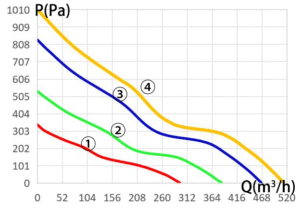
It is important to understand that maximum airflow and maximum static pressure are measured at different points on the fan performance curve. They should not be interpreted as simultaneously available operating values.
For high-resistance cooling systems, engineers should review the airflow performance curve and match it with the system resistance curve to determine the actual operating point.
3. Designed for High-Resistance Cooling Systems
In electronic equipment, airflow resistance can come from several sources:
- Dense electronic component layouts
- Heat sinks and cooling channels
- Air filters and protective grilles
- Narrow ventilation passages
- Ducts and internal airflow restrictions
When system resistance increases, a fan with insufficient static pressure may deliver less airflow than expected.
The 12038B offers several rated pressure configurations, including 340.0 Pa, 535.0 Pa, 834.7 Pa, and 1,010.0 Pa.
This range allows equipment designers to compare different fan configurations when developing cooling systems with demanding airflow requirements.
The final selection should always be based on the required operating point rather than maximum airflow or maximum static pressure alone.
4. Signal and Control Functions
The 12038B supports optional signal functions for fan speed control and operating-status monitoring.
Available configurations include:
| Function Code | Description |
|---|---|
| 0 | No signal function |
| 1 | PWM duty-cycle speed control |
| 2 | High-level fault alarm |
| 3 | Tachometer (RPM) feedback |
| 4 | PWM speed control + high-level fault alarm |
| 5 | PWM speed control + tachometer feedback |
These options allow the fan to be integrated into equipment requiring speed adjustment, rotational speed monitoring, or fan fault indication.
The required signal function should be specified when requesting a quotation or confirming the product model.
5. Environmental Adaptability and Testing
The 12038B product specifications list environmental adaptability ratings for three application categories:
- Ground / vehicle-mounted applications
- Marine / naval applications
- Airborne applications
The published environmental information references the following GJB standards and test conditions.
| Environmental Item | Published Requirement |
|---|---|
| High temperature | Ground: storage 80°C, operation 75°C; marine/airborne: storage 95°C, operation 85°C |
| Low temperature | Ground: storage –50°C, operation –40°C; marine/airborne: storage –60°C, operation –55°C |
| Rain / water ingress | Enhanced test, 1 hour per surface |
| Damp heat | 30–60°C, RH 95% ±5%, 24 hours per cycle, 10 cycles |
| Fungus resistance | Group 1 or Group 2, 28 days |
| Salt spray | Ground/marine: neutral salt spray, 192 hours; airborne: acidic salt spray, 192 hours |
| Sand and dust | Blowing sand and dust test |
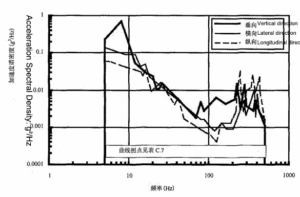
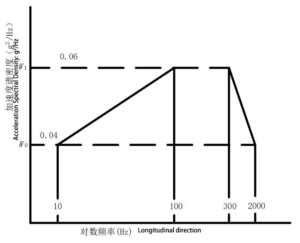
| Acceleration | Three-axis, six-direction; 9g performance test level and 13.5g structural test level |
| Shock | Ground: 20g; marine/airborne: 30g |
| Low air pressure | Airborne application: 6.3 kPa |
| Acidic atmosphere | Airborne application: 2-hour spray + 22-hour storage per cycle, 3 cycles |
| EMC | GJB151B-2013, RE102 and CE102 |
| Power supply characteristics | GJB181B-2012; abnormal overvoltage 50V/50ms |
| Vibration | GJB150.16A-2009 |
The published specification references include:
- GJB150.2A-2009 – Low Air Pressure
- GJB150.3A-2009 – High Temperature
- GJB150.4A-2009 – Low Temperature
- GJB150.8A-2009 – Rain
- GJB150.9A-2009 – Damp Heat
- GJB150.10A-2009 – Fungus
- GJB150.11A-2009 – Salt Fog
- GJB150.12A-2009 – Sand and Dust
- GJB150.15A-2009 – Acceleration
- GJB150.16A-2009 – Vibration
- GJB150.18A-2009 – Shock
- GJB150.28A-2009 – Acidic Atmosphere
- GJB151B-2013 – Electromagnetic Compatibility
- GJB181B-2012 – Aircraft Electrical Power Characteristics
Environmental ratings and test conditions depend on the selected product configuration. Customers should confirm the applicable rating and supporting test documentation for their specific project.
6. Typical Applications
With its high airflow and static pressure options, the 12038B can be evaluated for cooling systems where airflow resistance and heat dissipation requirements are important.
Power Electronics and Converters
Power conversion equipment may contain heat-generating components, heat sinks, and restricted airflow passages. Fan selection should account for the complete ventilation path.
Communication and Radar Subsystems
Communication and radar equipment may require forced-air cooling for densely arranged electronic components. The required airflow, static pressure, and environmental conditions should be considered together.
Industrial Control Cabinets
Control cabinets containing power electronics, automation components, and other heat-generating devices may benefit from appropriately designed forced-air ventilation.
Vehicle-Mounted Electronic Equipment
Mobile electronic systems can involve installation constraints, vibration, and changing environmental conditions. The appropriate fan configuration should be selected according to the equipment’s electrical and environmental requirements.
Specialized Electronic Enclosures
For high-density electronic enclosures, engineers should evaluate the airflow path, internal resistance, heat distribution, and available installation space before choosing a fan.
7. How to Select the Right 12038B Configuration
When evaluating the 12038B for an OEM project, consider the following factors:
- Power supply: Confirm whether the equipment uses a 12V, 24V, 28V, or 48V DC power system.
- Required airflow: Estimate the cooling airflow based on equipment heat generation and thermal design.
- System resistance: Consider filters, heat sinks, grilles, ducts, and other airflow restrictions.
- Static pressure: Compare the required system pressure with the fan’s performance curve.
- Noise and power: Evaluate the rated noise and electrical power consumption of each configuration.
- Control functions: Determine whether PWM speed control, tachometer feedback, or fault alarm functions are required.
- Environmental conditions: Confirm the applicable temperature, humidity, salt spray, vibration, shock, and other project requirements.
Providing these details during the quotation process helps identify a suitable fan configuration for further technical evaluation.
8. SenharFans DC Axial Fan Solutions
SenharFans supplies DC axial fans, AC axial fans, DC blower fans, DC condensing fans, centrifugal fans, and integrated motor assemblies for industrial and specialized cooling applications.
Our team works with OEM customers and equipment manufacturers to review fan dimensions, electrical specifications, airflow requirements, control functions, and environmental conditions.
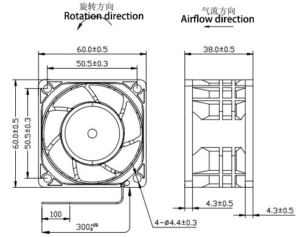
For the 12038B DC axial fan, customers can request product specifications, dimensional drawings, performance curves, and configuration details to support equipment integration.
Looking for a high static pressure 120 mm DC axial fan?
Contact SenharFans to discuss your cooling requirements and identify a suitable configuration.
- Website: https://senharfans.com/
- Email: sales@senharfans.com
- Phone / WhatsApp: +86-138-1239-0890
Conclusion
The SenharFans 12038B DC Axial Flow Fan is designed for cooling applications requiring high airflow and strong static pressure in a 120 × 120 × 38 mm form factor.
With multiple voltage and speed configurations, airflow ratings up to 513.9 m³/h, and static pressure ratings up to 1,010 Pa, the series provides several options for industrial electronics, communication equipment, power systems, and specialized electronic enclosures.
For high-resistance cooling systems, selecting the right configuration requires more than comparing maximum airflow values. Engineers should evaluate the fan performance curve, system resistance, electrical requirements, and environmental conditions together.