6032B DC Axial Fan: High Static Pressure Cooling for Demanding Applications
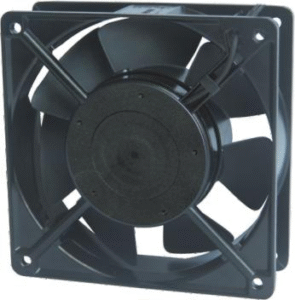
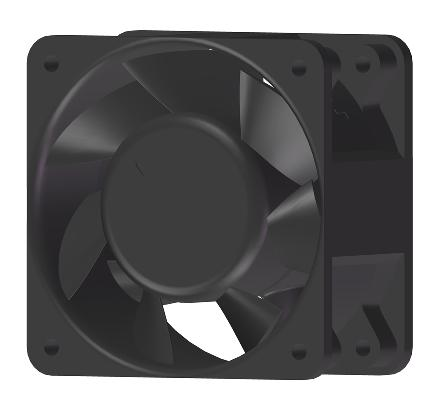
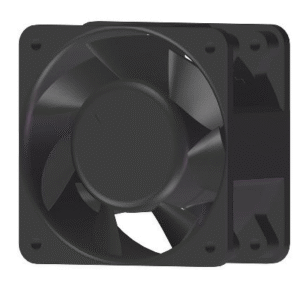
The 6032B DC axial fan is designed for electronic systems that require substantial airflow and high static pressure within a compact 60 × 60 × 32 mm form factor. Featuring an aluminum alloy frame, an aerospace-grade plastic impeller, and dual ball bearings, this fan is intended for demanding thermal management applications where installation space, airflow resistance, and environmental requirements must be considered together.
With rated configurations reaching speeds of 13,000 RPM, the 6032B delivers a listed maximum airflow of 123.5 m³/h and a maximum static pressure of 504.2 Pa. These specifications make it a candidate for evaluating cooling solutions in high-density electronic assemblies, power modules, radar equipment, and other systems with restricted airflow paths.
1. Key Design Features
Aluminum Alloy Frame and Aerospace-Grade Plastic Impeller
The 6032B combines an aluminum alloy frame with an aerospace-grade plastic impeller, according to the product specifications. This construction provides a metal frame structure while retaining a lightweight impeller design.
For equipment designers, material selection should be considered alongside mounting conditions, operating temperature, vibration exposure, and the mechanical requirements of the complete assembly.
Dual Ball Bearing Structure
The fan uses dual ball bearings. Bearing configuration is one of the factors to consider when evaluating a cooling fan for equipment with extended operating schedules or demanding installation conditions.
Actual service life depends on the selected model, operating temperature, mounting orientation, vibration, electrical conditions, and other application-specific factors. Confirm the applicable service-life data with the manufacturer when designing for a defined operating-life requirement.
High Airflow and Static Pressure
The 6032B product series includes two listed performance levels:
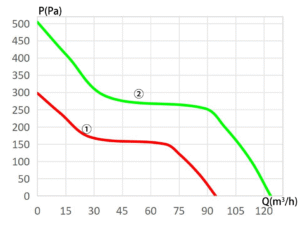
- 10,000 RPM, with airflow of 94.4 m³/h and static pressure of 298.0 Pa
- 13,000 RPM, with airflow of 123.5 m³/h and static pressure of 504.2 Pa
These figures are useful for preliminary comparison, but they should not be interpreted as airflow and pressure values that necessarily occur simultaneously. The actual operating point depends on the fan’s performance curve and the resistance of the installed cooling system.
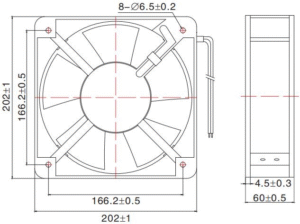
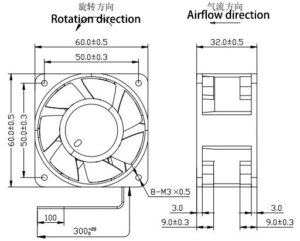
Product image: Mechanical dimensions
2. 6032B DC Axial Fan Specifications
| Parameter | Specification |
|---|---|
| Fan dimensions | 60 × 60 × 32 mm |
| Frame material | Aluminum alloy |
| Impeller material | Aerospace-grade plastic |
| Bearing type | Dual ball bearings |
| Weight | 130 g |
| Available voltage options | 5V, 12V, 24V, 28V, 48V |
| Rated performance configurations listed | 12V, 24V, 28V |
| Maximum listed speed | 13,000 RPM |
| Maximum listed airflow | 123.5 m³/h |
| Maximum listed static pressure | 504.2 Pa |
| Listed noise range | 63.5–69.2 dBA |
Performance Data by Model
| Model Number | Rated Voltage | Operating Voltage | Speed | Airflow | Static Pressure | Noise | Power |
|---|---|---|---|---|---|---|---|
| J60FZW1J0-32B00 | 12V | 8.0–13.8V | 10,000 RPM | 94.4 m³/h | 298.0 Pa | 63.5 dBA | 13.2 W |
| J60FZW1J3-32B00 | 12V | 8.0–13.8V | 13,000 RPM | 123.5 m³/h | 504.2 Pa | 69.2 dBA | 21.8 W |
| J60FZW2J0-32B00 | 24V | 16.0–27.6V | 10,000 RPM | 94.4 m³/h | 298.0 Pa | 63.5 dBA | 13.2 W |
| J60FZW2J3-32B00 | 24V | 16.0–27.6V | 13,000 RPM | 123.5 m³/h | 504.2 Pa | 69.2 dBA | 21.8 W |
| J60FZW3J0-32B00 | 28V | 18.0–32.0V | 10,000 RPM | 94.4 m³/h | 298.0 Pa | 63.5 dBA | 13.2 W |
| J60FZW3J3-32B00 | 28V | 18.0–32.0V | 13,000 RPM | 123.5 m³/h | 504.2 Pa | 69.2 dBA | 21.8 W |
The product page also lists 5V and 48V as available voltage options. Performance data for those versions should be confirmed separately before final selection.
3. Control and Monitoring Options
Different electronic systems have different requirements for speed adjustment and operating-status monitoring. The 6032B series lists the following signal-function options:
| Function Code | Description |
|---|---|
| 0 | No signal function |
| 1 | PWM speed control |
| 2 | High-level fault alarm |
| 3 | Tachometer (RPM) feedback |
| 4 | PWM speed control + high-level fault alarm |
| 5 | PWM speed control + tachometer feedback |
PWM control can support system-level fan-speed management, while tachometer feedback provides rotational-speed information for monitoring. A fault-alarm output can be incorporated into a system’s monitoring logic, subject to the electrical interface and signal definition of the selected model.
When requesting a quotation, specify the required voltage, control function, monitoring interface, connector, cable arrangement, and any relevant system-level electrical requirements.
4. Environmental Adaptability and Qualification
The 6032B product page lists environmental adaptability options for ground or vehicle-mounted equipment, marine or naval applications, and airborne applications. It also references a range of GJB environmental and electrical test standards.
Listed test areas include:
- High- and low-temperature exposure
- Rain and water exposure
- Damp heat and humidity
- Fungus resistance
- Salt spray
- Sand and dust
- Acceleration and shock
- Low air pressure for applicable ratings
- Acidic atmosphere for applicable ratings
- Electromagnetic compatibility
- Power-supply characteristics and abnormal overvoltage
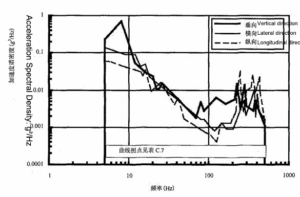
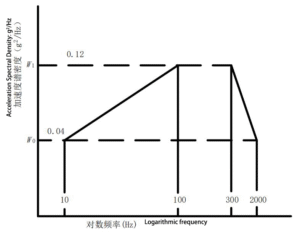
- Vibration
The applicable conditions depend on the selected environmental rating. For example, the product table lists different temperature limits and shock conditions for different application categories.
These listings should be checked against the precise model code, qualification records, and test documentation required for the intended equipment. A product-series description alone should not be treated as evidence that every configuration meets every listed condition.
5. Typical Application Areas
The 6032B may be evaluated for cooling applications where a compact fan must operate against significant airflow resistance.
Defense and Electronic Equipment
Electronic enclosures, power modules, and equipment assemblies may require forced airflow through restricted passages. Fan selection should account for heat dissipation, system impedance, available space, and environmental requirements.
Radar and Communication Systems
Radar electronics and communication equipment can contain components with concentrated heat loads. The 6032B’s listed airflow and static-pressure characteristics provide a starting point for evaluating forced-air cooling arrangements.
Marine and Naval Electronics
Shipboard electronics may face vibration, humidity, salt exposure, and temperature variations. The appropriate environmental rating and supporting test documentation should be confirmed for the intended installation.
Vehicle-Mounted Systems
Vehicle-mounted electronics and mobile equipment may have limited installation space and demanding vibration conditions. The selected fan configuration should be assessed against the equipment’s mechanical, thermal, and electrical requirements.
Airborne Equipment
For airborne applications, confirm the required environmental qualification, operating temperature, vibration conditions, electrical characteristics, and applicable equipment standards before specifying a model.
Industrial Control and Power Electronics
Industrial control cabinets, power conversion equipment, and other high-density electronic assemblies may benefit from forced-air cooling. The fan’s actual operating point should be evaluated within the complete enclosure or duct system.
6. How to Select the Right 6032B Configuration
Before integrating the fan into a product, engineering teams should review several factors.
1. Confirm the heat load.
Estimate the heat generated by the components and determine the cooling airflow required to maintain acceptable operating temperatures.
2. Evaluate system resistance.
Filters, heat sinks, ducts, grilles, and narrow airflow passages all affect the operating point. Use the fan performance curve to evaluate the expected airflow under actual system resistance.
3. Match the power supply.
Select the appropriate rated-voltage configuration and verify that the available supply remains within its specified operating range.
4. Choose the required signal functions.
Determine whether the application needs PWM speed control, tachometer feedback, a fault-alarm output, or a combination of these functions.
5. Confirm environmental requirements.
Identify the applicable ground, marine, or airborne rating and verify the supporting test records for the exact model.
6. Review acoustic and power constraints.
The listed 6032B configurations have noise ratings of 63.5–69.2 dBA and power ratings of 13.2–21.8 W. Evaluate these characteristics against the system’s acoustic limits, power budget, and cooling requirements.
7. Request Technical Support from SenharFans
SenharFans supplies DC axial fans for industrial and specialized electronic cooling applications. The 6032B series offers multiple rated performance configurations and optional control and monitoring functions for system-integration projects.
When requesting a quotation or technical review, please provide:
- Required voltage and target airflow
- Estimated system resistance or required static pressure
- Available installation space
- Operating temperature and environmental conditions
- Required PWM, tachometer, or fault-alarm functions
- Expected operating schedule and any applicable qualification requirements
- Estimated order quantity
The engineering team can then review the application requirements and help identify a suitable configuration.
Contact: sales@senharfans.com
Website: SenharFans
For model-specific performance data, mechanical dimensions, and environmental qualification details, consult the product documentation and confirm the requirements with SenharFans before final integration.