Cooling Fan Rotation Direction vs. Airflow Direction: What OEM Engineers Need to Know
Primary Keyword: cooling fan airflow direction
Secondary Keywords: cooling fan rotation direction, axial fan airflow, DC axial fan, OEM cooling fan, industrial fan installation, cooling fan replacement
Introduction
When selecting or replacing an industrial cooling fan, engineers often focus on dimensions, voltage, airflow, and static pressure.
However, two other details are equally important for equipment integration: rotation direction and airflow direction.
These terms are related, but they do not mean the same thing.
Rotation direction describes which way the fan’s impeller rotates when viewed from a specified side. Airflow direction describes the direction in which air moves through the fan.
Confusing these two parameters can lead to incorrect installation, poor air circulation, or incompatibility with the equipment’s intended cooling design.
For OEM manufacturers, system integrators, and maintenance teams, confirming both directions before ordering can help avoid unnecessary modifications and delays.
This guide explains the difference between rotation direction and airflow direction, how they affect installation, and what information to confirm when sourcing an industrial cooling fan.
1. What Is Cooling Fan Rotation Direction?
Rotation direction describes the direction in which the fan impeller turns when viewed from a defined reference side.
It is commonly specified as clockwise (CW) or counterclockwise (CCW).
However, the viewing position matters.
A fan described as rotating clockwise when viewed from one side may appear to rotate counterclockwise when viewed from the opposite side.
For this reason, a specification that simply says “CW” or “CCW” may be insufficient unless the reference viewing side is clearly identified.
When reviewing a datasheet or drawing, check how the manufacturer defines the viewing direction.
If the information is unclear, ask the supplier to confirm the reference side before approving the product.
2. What Is Cooling Fan Airflow Direction?
Airflow direction indicates the direction in which air passes through the fan.
For a typical axial fan, air generally enters one side of the fan and exits the opposite side along the rotational axis.
The airflow direction should match the intended ventilation path of the equipment.
For example, an electronic enclosure may be designed to draw cooler air through an inlet and discharge heated air through an outlet. Installing a fan with the wrong airflow direction can disrupt this intended path.
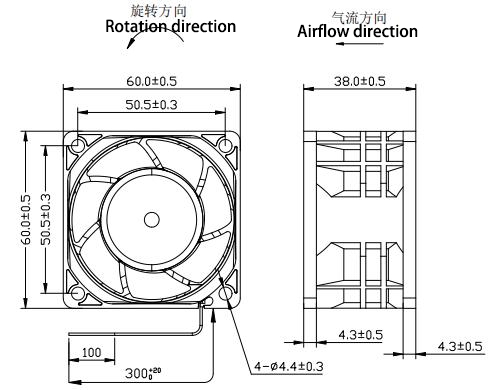
Airflow direction may be indicated by arrows on the fan housing or through diagrams in the product documentation.
However, markings and conventions can vary by manufacturer and product.
Practical tip: If the fan has no clearly visible airflow marking, confirm the direction using the manufacturer’s drawing or written technical specification rather than guessing from the impeller shape.
3. Rotation Direction and Airflow Direction Are Not the Same
Although rotation and airflow are related through the fan’s aerodynamic design, they describe different characteristics.
| Parameter | Rotation Direction | Airflow Direction |
|---|---|---|
| What it describes | Direction of impeller rotation | Direction of air movement |
| Common notation | CW or CCW | Airflow arrow or inlet-to-outlet indication |
| Reference requirement | Viewing side must be defined | Inlet and outlet sides must be identified |
| Main integration concern | Compatibility with the specified fan design | Compatibility with the equipment’s ventilation path |
| How to verify | Datasheet, drawing, or specified observation method | Airflow marking, drawing, or manufacturer confirmation |
The important point is that confirming one parameter does not automatically confirm the other.
When ordering a fan, especially a customized model or replacement product, both requirements should be documented independently.
4. Why Airflow Direction Matters in Equipment Design
The fan is only one part of the complete cooling system.
The equipment’s inlet openings, internal components, heat sources, ducts, filters, and exhaust openings all influence how air moves through the system.
The airflow direction must therefore be considered as part of the overall thermal design.
Industrial Control Cabinets
A control cabinet may use fans to introduce cooler air, extract warm air, or establish a defined ventilation path.
The selected direction should match the cabinet’s airflow layout.
If air is discharged into a restricted area or drawn from an unsuitable location, the resulting airflow may not provide the intended cooling effect.
Electronic Equipment
Electronic assemblies may contain heat-generating components arranged within limited space.
The airflow path should help move air through the areas that require cooling rather than allowing most of the air to bypass those components.
The direction of the fan, the location of openings, and the arrangement of internal components should be considered together.
HVAC and Industrial Machinery
In HVAC equipment and industrial machinery, the fan may be part of a larger airflow or heat-exchange arrangement.
The intended inlet and outlet directions should be confirmed against the equipment drawing and the system’s operating requirements.
A fan that fits mechanically may still be unsuitable if its airflow direction does not match the required design.
5. Can You Reverse the Rotation Direction to Reverse Airflow?
This is a common question, particularly when an existing fan needs to be replaced.
The answer depends on the fan design.
For many conventional axial fans, simply reversing the electrical connections is not a valid way to reverse rotation. Brushless DC fans contain electronic drive circuits, and reversing the supply polarity can damage the fan unless the product is specifically designed to tolerate it.
Even when a fan design supports reverse rotation, the resulting airflow and pressure performance may differ from its intended operating direction.
Blade geometry, motor design, and the fan’s aerodynamic characteristics all affect performance.
Therefore, do not assume that reversing the electrical supply or rotation will provide equivalent airflow in the opposite direction.
If your equipment requires reversible airflow, specify that requirement to the manufacturer and confirm that the proposed model supports the intended operating modes.
6. What Should You Check When Replacing an Existing Fan?
When replacing a cooling fan without redesigning the equipment, matching the external dimensions is only the first step.
Before approving a replacement, confirm the following.
Mechanical Compatibility
- Overall dimensions and thickness
- Mounting-hole positions
- Installation orientation
- Connector location
- Available clearance around the inlet and outlet
Airflow Compatibility
- Required airflow direction
- Required airflow performance
- Expected system resistance
- Position of inlet and outlet openings
- Compatibility with the equipment’s internal airflow path
Electrical Compatibility
- Rated voltage
- Current and power requirements
- Connector type and pin assignment
- Speed-control requirements
- Tachometer or alarm functions, if needed
Environmental Compatibility
- Operating temperature
- Humidity and moisture exposure
- Dust and water protection requirements
- Corrosion resistance, where applicable
- Vibration and other application-specific conditions
A replacement fan should be evaluated against the original equipment’s requirements, not just its appearance.
7. How to Confirm the Correct Fan Direction Before Ordering
For OEM projects, the simplest way to reduce uncertainty is to include clear direction information in the technical specification.
Useful supporting information includes:
- A product drawing showing the reference viewing side
- An arrow indicating the required airflow direction
- A clear indication of the inlet and outlet sides
- Photographs of the existing installation
- The original fan model number, if available
- Any restrictions on the installation orientation
For customized fans, the drawing should reflect the agreed configuration.
If direction is critical to the application, request written confirmation from the supplier before sample approval or mass production.
This is particularly useful when multiple departments are involved in the project, because purchasing, engineering, and production teams need to work from the same specification.
8. What If the Required Direction Is Not Available in a Standard Model?
Sometimes a standard fan configuration does not match the mechanical or airflow requirements of the equipment.
Depending on the product design and project requirements, possible approaches may include evaluating another suitable model, changing the mounting arrangement, or discussing a customized solution with the manufacturer.
Before making a change, consider the full effect on:
- Airflow and static pressure performance
- Available installation space
- Electrical interface
- Noise and power consumption
- Environmental requirements
- Product validation and delivery schedule
A mechanical change that appears simple may affect other parts of the cooling system.
For this reason, any proposed alternative should be evaluated against the actual application requirements.
9. Information to Include in an OEM Cooling Fan Inquiry
If your project has specific rotation or airflow requirements, include these details in your RFQ:
- Application and equipment description
- Required fan dimensions
- Rated voltage and electrical interface
- Required airflow performance
- Required airflow direction
- Rotation direction and reference viewing side, if specified
- Connector and cable requirements
- Installation drawing or photographs
- Operating environment
- Sample quantity and expected production demand
If you are replacing an existing fan, include the original model number and photographs of the installation whenever possible.
This information helps the supplier evaluate the application rather than relying on assumptions based on dimensions alone.
How SenharFans Supports OEM Cooling Fan Integration
SenharFans supplies DC axial fans, DC blower fans, AC axial fans, and customized cooling fan solutions for industrial and electronic equipment applications.
For OEM projects, our team can review installation dimensions, airflow requirements, electrical interfaces, environmental conditions, and other application-specific requirements.
Rotation direction, airflow direction, and the available configuration should be confirmed against the selected model’s technical documentation.
If a standard product does not meet the application’s requirements, the feasibility of an alternative or customized solution can be evaluated according to the project specifications.
Contact SenharFans
Website: https://senharfans.com/
Email: sales@senharfans.com
WhatsApp: +86-138-1239-0890
Contact us with your application details and technical requirements to discuss a suitable cooling fan solution.
Frequently Asked Questions
What is the difference between fan rotation direction and airflow direction?
Rotation direction describes how the impeller turns when viewed from a defined side. Airflow direction describes the direction in which air moves through the fan. Both should be confirmed separately.
How can I identify the airflow direction of an axial fan?
Check the airflow arrow on the housing, the manufacturer’s drawing, or the product documentation. If the direction is not clearly indicated, ask the supplier to confirm it.
Can I reverse a DC fan’s power connections to change its airflow direction?
Not unless the specific product is designed for that operation. Brushless DC fans contain electronic drive circuits, and reversing supply polarity may damage the fan. Confirm the manufacturer’s instructions before connecting the fan.
Can a replacement fan have the same dimensions but a different airflow direction?
Yes. Mechanical dimensions alone do not guarantee that the airflow direction or other operating characteristics will match the original product.
What information should I send when requesting a replacement fan?
Provide the original model number, dimensions, voltage, airflow requirements, direction information, connector details, and photographs or drawings of the installation when available.