What OEM Buyers Should Prepare Before Requesting a Cooling Fan Quote
When sourcing cooling fans for industrial equipment, electronic assemblies, or customized products, requesting a quotation is often one of the first steps in supplier evaluation.
However, a fan quotation is only as accurate as the technical information provided. If key requirements such as dimensions, operating voltage, airflow, static pressure, and environmental conditions are missing, it may be difficult for a manufacturer to recommend the right model.
For OEM buyers, preparing a clear technical brief before contacting a cooling fan manufacturer can help streamline communication, improve model selection, and reduce unnecessary delays during product development.
Here are seven important points to consider before requesting a cooling fan quotation.
1. Define the Application and Cooling Requirements
Start by explaining where the cooling fan will be used and what it needs to cool.
Different applications can have very different thermal-management requirements. A fan used in an industrial control cabinet may face different airflow restrictions from one installed in a communication device or a compact electronic assembly.
Before contacting a supplier, consider the following questions:
- What equipment or components need cooling?
- How much heat does the equipment generate?
- What is the maximum acceptable operating temperature?
- How much airflow is required?
- Will the fan operate continuously or intermittently?
If the required airflow has not yet been determined, provide as much information as possible about the equipment and its operating conditions. A qualified supplier may be able to help evaluate suitable options, although final selection should be verified in the actual system.
2. Confirm the Required Fan Dimensions
Mechanical compatibility is essential when integrating a cooling fan into an existing product or a new OEM design.
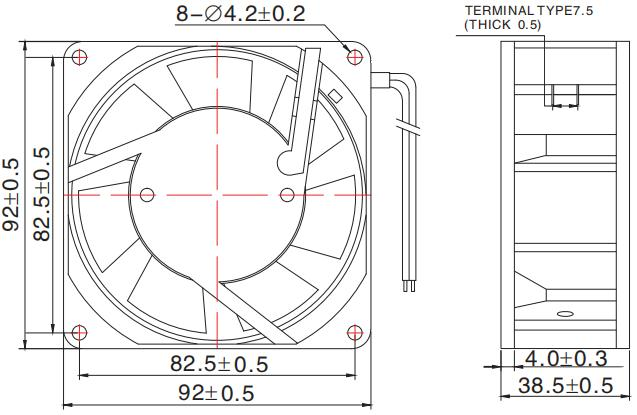
Provide the available installation space and specify the required fan dimensions, including:
- Frame length and width
- Fan thickness
- Mounting-hole positions
- Connector location and cable requirements
- Airflow direction and rotation requirements, where applicable
For replacement projects, share the original fan’s model number, datasheet, mechanical drawing, or clear photographs if available.
A fan with similar external dimensions is not necessarily a suitable replacement. Differences in airflow performance, voltage, current, connector wiring, and mounting details may affect compatibility.
For new equipment designs, confirming these requirements early can help avoid mechanical changes later in development.
3. Specify Voltage and Electrical Requirements
Cooling fans are available in different electrical configurations. Selecting the correct voltage is only the first step in confirming compatibility.
When requesting a quotation, provide the following information where applicable:
- Rated input voltage
- Allowable operating-voltage range
- Available power supply
- Current or power constraints
- Connector type and pin configuration
- Startup and operating requirements
If the equipment requires a specific electrical interface, include that information in the inquiry.
For example, a replacement fan may operate at the correct nominal voltage but still be unsuitable because its connector or signal interface differs from the original design.
Confirming electrical compatibility before ordering samples helps reduce avoidable integration problems.
4. Provide Airflow and Static-Pressure Requirements
Airflow and static pressure are two important parameters when selecting a cooling fan.
Airflow describes the volume of air moved by the fan, while static pressure relates to its ability to overcome resistance in the airflow path.
Filters, grilles, heat sinks, narrow passages, and densely arranged components can restrict airflow after the fan is installed.
This means that a fan’s maximum airflow rating under free-air conditions may not represent the airflow it delivers inside the finished equipment.
For more accurate selection, OEM buyers should provide the required airflow and, where available, the expected system pressure drop.
They should also request the manufacturer’s airflow–static pressure (P–Q) curve for the relevant model and operating conditions.
When comparing quotations, make sure the proposed fan can meet the required airflow at the expected system resistance rather than comparing maximum airflow figures alone.
If the pressure drop is unknown, tell the supplier. This helps establish what additional information or testing may be needed before final model approval.
5. Identify Environmental and Reliability Requirements
The operating environment can influence fan construction, material selection, bearing choice, motor design, and environmental protection.
Depending on the application, relevant conditions may include:
- High or low operating temperatures
- Humidity or damp heat
- Dust and airborne contaminants
- Water exposure
- Salt spray or corrosive environments
- Shock and vibration
- Electromagnetic compatibility requirements
OEM buyers should identify which conditions are essential and which are optional.
If a project requires compliance with a specific standard, provide the standard number and applicable test conditions. Do not rely on general descriptions such as “industrial grade” or “military grade” as a substitute for the required documentation.
Ask the manufacturer to confirm whether the proposed model has the necessary supporting test reports or qualification documents.
Environmental ratings and test results should be checked for the exact model and configuration under consideration.
6. Confirm Control, Monitoring, and Noise Requirements
Some applications require only a basic power connection, while others need additional control or monitoring functions.
Depending on the fan model, available options may include:
- PWM speed control: Allows a compatible controller to adjust fan speed through a supported PWM input.
- FG or tachometer feedback: Provides a signal that can be used to monitor fan rotation speed.
- Fault-alarm output: Provides a signal indicating a specified fault condition according to the model’s electrical interface.
If these functions are required, specify them in the initial inquiry. The supplier should confirm signal availability, electrical characteristics, wiring, and compatibility with the customer’s controller.
Noise should also be considered where acoustic performance matters.
When comparing noise specifications, check whether the measurements were obtained under comparable test conditions. Fan speed, airflow, installation, and measurement methods can all affect the results.
The objective is to select a fan that meets the equipment’s cooling requirements without overlooking its electrical, acoustic, and integration constraints.
7. Clarify Quantity, Project Stage, and Delivery Requirements
Technical specifications are not the only information needed for a useful quotation. The commercial context also matters.
Before contacting a manufacturer, consider preparing the following details:
- Estimated sample quantity
- Initial order quantity
- Expected annual demand, if known
- Project development stage
- Target delivery schedule
- Customization requirements
- Required technical documents
- Destination country and shipping requirements
Indicate whether the inquiry is for prototype evaluation, qualification testing, a production order, or an ongoing supply program.
This information helps the supplier understand the project’s current needs and respond more appropriately.
If a custom configuration is required, ask the manufacturer to clarify the development process, sample arrangements, technical approval steps, and production lead time.
Delivery schedules should be confirmed against the selected model, order quantity, customization requirements, and current production arrangements.
A Practical Checklist for Cooling Fan RFQs
Before sending your request for quotation (RFQ), check whether you can provide the following information.
| Information | What to provide |
|---|---|
| Application | Equipment type and cooling purpose |
| Dimensions | Frame size, thickness, mounting, and airflow direction |
| Electrical requirements | Rated voltage, operating range, and power constraints |
| Cooling performance | Required airflow and expected static pressure, if known |
| Control functions | PWM, FG feedback, fault alarm, or other interface requirements |
| Operating environment | Temperature, humidity, dust, water, vibration, and applicable standards |
| Quantity | Sample quantity, initial order, and estimated future demand |
| Schedule | Required sample and production delivery dates |
| Documentation | Drawings, performance curves, test reports, and other project-specific documents |
Not every project will have all these details available at the beginning. If some requirements remain undecided, identify them clearly rather than guessing.
A preliminary discussion with the manufacturer can help determine which specifications must be finalized before a model is selected.
Why Clear Technical Information Matters When Choosing a Manufacturer
A useful cooling fan quotation should do more than provide a unit price.
For OEM projects, buyers should also consider whether the supplier can provide relevant technical documentation, explain model differences, clarify electrical and mechanical compatibility, and support sample evaluation.
When reviewing quotations, compare equivalent configurations and check the conditions behind the stated performance figures.
A lower-priced fan may not be the most suitable option if it cannot deliver the required airflow at the system’s operating pressure or meet the project’s electrical and environmental requirements.
Likewise, a model with higher maximum airflow is not automatically the best choice if it creates excessive noise, exceeds power constraints, or does not fit the installation.
Clear technical communication helps buyers compare suitable options and make more informed sourcing decisions.
Contact SenharFans for Cooling Fan Requirements
SenharFans offers a range of cooling products, including DC axial fans, AC axial fans, DC blower fans, DC condensing fans, centrifugal fans, and integrated motor assemblies.
For OEM equipment manufacturers, distributors, and industrial buyers, sharing the application, required dimensions, electrical specifications, cooling targets, and environmental conditions is a useful starting point for discussing suitable products.
If your project is still in the development stage, you can also explain which requirements have already been confirmed and which remain under evaluation.
To discuss your application or request product information, contact sales@senharfans.com.
Providing clear requirements at the beginning helps both parties evaluate the project more efficiently and determine the appropriate next steps.