Cooling Technology: Trends and Applications in Industrial Cooling Fans
As electronic equipment becomes more compact and powerful, effective thermal management is increasingly important for maintaining stable system operation. From industrial control cabinets and communication equipment to radar electronics and specialized electronic systems, cooling fans help remove heat and support reliable equipment performance.
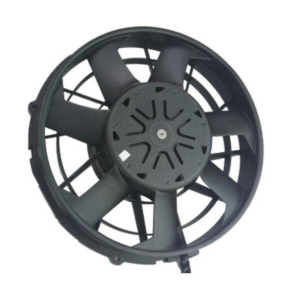
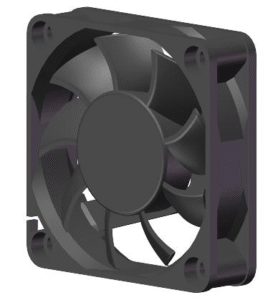
SenharFans develops DC and AC axial fans, DC blower fans, DC condensing fans, centrifugal fans, and integrated motor assemblies for different cooling requirements. Understanding current cooling technology trends can help equipment manufacturers and engineers select suitable fan solutions for their applications.
1. The Evolution of Cooling Technology
Traditional cooling systems often relied on fixed-speed fans selected primarily according to airflow requirements. As electronic systems have become smaller and more thermally demanding, fan selection has become more complex.
Modern cooling design must consider several factors together:
- Airflow: The volume of air needed to remove heat from the equipment.
- Static pressure: The fan’s ability to overcome resistance from filters, grilles, ducts, and compact airflow paths.
- Power consumption: The electrical power required to deliver the necessary cooling performance.
- Noise: The acoustic requirements of the equipment and its operating environment.
- Reliability: The expected operating conditions, bearing design, and required service life.
- Environmental conditions: Temperature, humidity, dust, salt spray, vibration, and other application-specific factors.
A suitable cooling solution balances these requirements rather than maximizing a single performance parameter.
2. High-Efficiency Cooling for Compact Electronics
Miniaturization creates a common thermal management challenge: less space is available for cooling, while electronic components may continue to generate substantial heat.
In these applications, engineers need to evaluate the entire airflow path, not just the fan’s free-air airflow rating. Restrictions inside an enclosure can reduce the actual airflow delivered to heat-generating components.
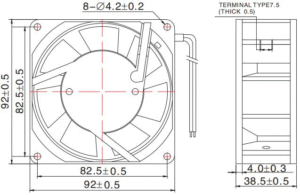
Choosing an appropriate fan involves reviewing its performance curve, the system’s airflow resistance, the available installation space, and the equipment’s thermal load.
SenharFans offers multiple fan types for different system configurations. Axial fans are commonly considered where air needs to move along the fan’s axis, while blower and centrifugal designs may be appropriate for applications with different airflow-path or pressure requirements.
The best choice depends on the equipment’s actual operating conditions and required cooling performance.
3. Cooling Fans for Industrial and Specialized Environments
Some cooling applications require fans to operate under conditions more demanding than those found in ordinary indoor equipment.
Industrial, vehicle-mounted, marine, and airborne systems may have specific requirements relating to:
- High- and low-temperature operation
- Humidity and moisture exposure
- Salt spray and corrosive atmospheres
- Sand and dust
- Mechanical shock and vibration
- Reduced air pressure
- Electromagnetic compatibility
The required capabilities depend on the application and the applicable qualification standards. A fan suitable for a conventional industrial enclosure should not automatically be assumed to meet marine, airborne, or defense-related environmental requirements.
For specialized projects, engineers should confirm the environmental rating, test conditions, and supporting documentation for the selected fan model.
SenharFans provides fan configurations for different industrial and specialized cooling requirements. Environmental suitability should be assessed against the actual operating conditions of each project.
4. The Role of Fan Control and Monitoring
Cooling technology is increasingly focused on controlling fan operation according to system requirements rather than running every fan continuously at a fixed speed.
Depending on the fan model and configuration, useful control and monitoring functions may include:
- PWM speed control: Allows a compatible controller to adjust fan speed through a pulse-width modulation signal.
- FG speed feedback: Provides a signal that can be used to monitor fan rotational speed.
- RD rotation detection: Supports monitoring of fan operating or fault status, according to the specified signal logic.
- Voltage-based speed control: Allows speed adjustment through a supported analog voltage input.
- Built-in protection functions: Depending on the model, may include reverse polarity protection, locked rotor protection, automatic restart, or soft start.
These functions can help equipment manufacturers integrate cooling into a broader control system. For example, a controller may adjust fan speed according to measured equipment temperature or use rotational-speed feedback to identify certain operating abnormalities.
However, the availability of these functions, their electrical requirements, and their behavior must be verified for the selected model. Fan speed feedback alone does not measure airflow or confirm that all components are adequately cooled.
5. Improving Thermal Management Through Better System Integration
Effective cooling depends on more than the fan itself. Fan placement, enclosure design, component layout, air inlet and outlet positions, and internal obstructions all influence thermal performance.
Engineers can improve cooling-system design by:
- Identifying the heat-generating components and their thermal requirements.
- Evaluating available installation space and the intended airflow path.
- Estimating airflow resistance from filters, grilles, ducts, and other components.
- Comparing fan performance curves against the system’s operating requirements.
- Confirming electrical compatibility, control functions, and environmental conditions.
- Testing the integrated equipment under representative operating conditions.
This system-level approach helps reduce the risk of selecting a fan that appears suitable on paper but cannot deliver the required cooling performance after installation.
For demanding applications, prototype testing and validation under the intended operating conditions remain important parts of the engineering process.
6. Choosing a Cooling Fan Manufacturer
When evaluating a cooling fan supplier, equipment manufacturers should consider more than the product catalogue.
Important factors include:
- Product range: Availability of fan types and configurations for different cooling requirements.
- Engineering support: Assistance with model selection, electrical interfaces, and application-specific requirements.
- Testing capabilities: Access to relevant performance and environmental testing.
- Customization: Ability to discuss suitable configurations for particular installation or operating requirements.
- Documentation: Clear specifications, wiring diagrams, performance curves, and applicable qualification information.
- Manufacturing and quality management: Processes that support consistent production and product verification.
SenharFans works with customers on cooling requirements for industrial equipment and specialized electronic applications. Our product range includes DC and AC axial fans, DC blower fans, DC condensing fans, centrifugal fans, and integrated motor assemblies.
The appropriate solution depends on the project’s required performance, electrical configuration, environmental conditions, and production needs.
7. Cooling Technology for Future Equipment Designs
As electronic equipment continues to evolve, cooling design will remain closely linked to component density, power consumption, control-system integration, and environmental requirements.
Several engineering priorities are likely to remain important:
- More effective use of limited installation space
- Better matching of fan performance to system resistance
- Appropriate speed control and operational monitoring
- Careful consideration of power consumption and acoustic requirements
- Verification of reliability under actual application conditions
Rather than relying on a single technology or specification, successful thermal management combines appropriate component selection, sound system design, and practical testing.
Conclusion
Cooling fans are important components in modern thermal management systems. Selecting the right fan requires balancing airflow, static pressure, power consumption, noise, reliability, and environmental suitability.
SenharFans offers a range of cooling fan products for industrial equipment and specialized electronic applications. By evaluating the actual requirements of each project, engineers can identify suitable fan configurations and integrate them more effectively into their equipment designs.
Discuss your cooling requirements with SenharFans.
Website: https://senharfans.com/
Email: sales@senharfans.com
Phone / Wechat: +86 138 1239 0890