How to Choose the Right Axial Fan for Industrial Electronics Cooling
In industrial electronics, choosing a cooling fan is not simply a matter of selecting the largest airflow rating available.
A fan that provides high free-air airflow may perform poorly once installed behind a filter, grille, heat sink, or protective enclosure. Similarly, a cooling fan that works well in a clean indoor environment may not be suitable for outdoor cabinets, marine equipment, radar systems, or airborne electronics.
For engineers, OEM manufacturers, distributors, and system integrators, the right fan selection should consider the actual operating conditions of the complete ventilation system.
This article explains the key factors to consider when selecting an axial fan or other cooling fan for industrial equipment.
1. Start With the Actual Heat Load
The first step in designing an industrial cooling system is understanding how much heat needs to be removed.
Electronic components, power supplies, drives, communication modules, control boards, and other equipment convert electrical energy into heat. If this heat cannot be dissipated effectively, the internal temperature of the enclosure will continue to rise.
A basic air-cooling calculation can provide an initial estimate of the required airflow.
For many applications, engineers can use the relationship between heat generation, allowable temperature rise, and airflow as a starting point.
However, this calculation should not be treated as the final fan selection.
The actual requirement also depends on:
- Cabinet structure
- Air inlet and outlet design
- Filter resistance
- Heat sink characteristics
- Ambient temperature
- Installation orientation
- Internal component layout
- Required reliability
- Altitude and air density
This is why selecting a cooling fan based only on its free-air CFM rating can lead to an undersized cooling system.
2. Free-Airflow Is Not the Same as Installed Airflow
One of the most common mistakes in fan selection is looking only at the maximum airflow listed on a datasheet.
For example, an axial fan may be rated for a certain airflow under free-air conditions. Once the fan is installed in an actual cabinet, the airflow will decrease because the system creates resistance.
Common sources of pressure loss include:
- Dust filters
- Protective grilles
- Heat sinks
- Narrow air passages
- Electronic components
- Ducts
- Louvers
- Exhaust filters
The relationship between airflow and static pressure is therefore critical.
When comparing an axial fan, cooling fan, or ventilation fan, engineers should review the P-Q curve and identify the expected operating point of the complete system.
A suitable fan should provide the required airflow at the actual system resistance—not simply at zero static pressure.
3. Axial Fan or Blower Fan?
The required airflow path also determines which fan type is appropriate.
Axial Fans
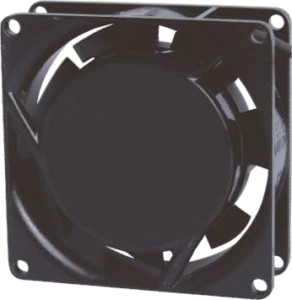
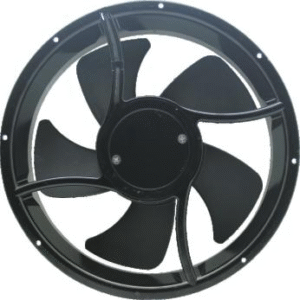
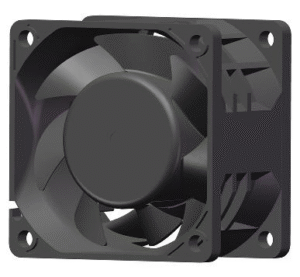
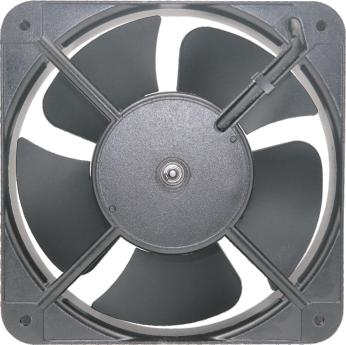
An axial fan moves air generally parallel to the fan shaft.
They are commonly used for:
- Control cabinet cooling
- Electronic equipment cooling
- HVAC systems
- Telecom equipment
- Radar cooling
- Marine electronics
- Industrial ventilation
Axial fans are particularly suitable when relatively high airflow is required with moderate system resistance.
Blower Fans
Blower fans are often preferred when the application requires higher static pressure or when air needs to travel through a more restrictive flow path.
They can be useful for:
- Compact electronic assemblies
- Narrow airflow channels
- High-resistance heat sinks
- Ducted systems
- Specialized equipment cooling
The correct choice depends on the complete airflow system rather than the fan name alone.
4. Should You Choose an EC Fan or DC Fan?
The terminology used by different suppliers can sometimes be confusing.
An EC fan generally refers to a fan using an electronically commutated motor. Many electronically commutated designs are brushless and provide electronic speed control.
For industrial applications, the important question is not simply whether a fan is called an EC fan or a DC fan.
Engineers should evaluate the actual electrical and control characteristics, including:
- Rated voltage
- Operating voltage range
- Power consumption
- Speed control method
- Tachometer output
- Alarm signal
- Locked-rotor protection
- Reverse-polarity protection
- Over-current protection
- Electromagnetic compatibility
For applications requiring variable airflow, PWM or analog speed control can be especially useful.
The fan can operate at lower speed when the thermal load is low and increase speed when additional cooling is required.
This approach can help reduce energy consumption and acoustic output while supporting longer operating life.
5. Consider the Real Ambient Temperature
A fan specification should always be evaluated against the actual operating environment.
An indoor electronics cabinet may operate at a relatively moderate ambient temperature. An outdoor cabinet exposed to direct sunlight can experience a significantly higher internal thermal load.
Applications such as:
- Outdoor telecom cabinets
- Solar equipment
- Industrial control cabinets
- Radar systems
- Transportation equipment
- Marine electronics
may experience large temperature variations.
When selecting a cooling fan, check:
Operating temperature range
Do not assume that a fan designed for a standard indoor environment will automatically be suitable for high-temperature applications.
Temperature can affect:
- Motor performance
- Bearing lubrication
- Electronic components
- PCB reliability
- Fan lifetime
For demanding applications, temperature testing and lifetime evaluation should be considered during the design stage.
6. IP Protection Matters in Harsh Environments
A standard electronics fan may work perfectly well in a clean laboratory but fail prematurely when exposed to dust, moisture, salt spray, or condensation.
For outdoor and harsh-environment applications, engineers should consider the required level of ingress protection.
Depending on the application, protection may involve:
- Sealed fan structures
- Conformal coating
- Encapsulated electronics
- Improved cable sealing
- Special bearing arrangements
- Corrosion-resistant materials
- Customized protective structures
For marine ventilation and coastal equipment, salt and humidity can be particularly challenging.
For dusty industrial environments, preventing particulate contamination of the motor and electronics may be equally important.
The required IP rating should therefore be determined from the actual environmental conditions rather than selected simply because a higher number appears better.
7. Noise Can Also Be a Design Requirement
Cooling performance is important, but noise can become a major issue in certain installations.
Examples include:
- Control rooms
- Communication equipment
- Medical or laboratory equipment
- HVAC systems
- Operator cabins
- Vehicle electronics
- Marine command spaces
Fan noise is influenced by:
- Fan speed
- Blade geometry
- Motor design
- Airflow resistance
- Turbulence
- Installation structure
- Grilles and filters
A speed-controlled cooling fan can sometimes provide a useful solution.
Instead of running continuously at maximum speed, the fan can adjust its RPM according to the thermal load.
This can reduce unnecessary noise while maintaining adequate cooling.
8. Reliability Should Be Evaluated as a System
For mission-critical cooling, fan reliability should not be evaluated only by looking at a single MTBF number.
A reliable cooling system requires consideration of the entire product and manufacturing process.
Important factors include:
Motor and Bearing Quality
The motor and bearing system directly influence operating life.
Electronic Protection
Protection against abnormal voltage, current, locked rotor, and other electrical conditions can improve system robustness.
Environmental Protection
Coatings, sealing, materials, and structural design should correspond to the application environment.
Manufacturing Consistency
Dynamic balancing, winding quality, assembly control, and production testing all influence final fan performance.
Quality Control
For OEM and industrial customers, traceability and consistent production are important, particularly when the fan becomes part of a long-life equipment platform.
This is especially important for mission-critical cooling, where a fan failure can affect the operation of the equipment being cooled.
9. What Should OEM Customers Ask a Fan Supplier?
For OEM manufacturers and system integrators, purchasing a fan should be more than comparing unit prices.
Before selecting an OEM fan supplier, consider asking for:
- Complete fan datasheet
- P-Q performance curve
- Operating temperature range
- Rated voltage and voltage range
- Power consumption
- Noise data
- Bearing information
- Expected service life
- Environmental test information
- IP protection information
- Speed-control specifications
- Alarm and tachometer functions
- Dimensional drawings
- Electrical interface information
- Sample availability
- Production lead time
- Quality management information
For customized applications, the supplier should also be able to discuss airflow requirements, mounting constraints, electrical interfaces, environmental conditions, and expected service life.
This technical communication is often more important than simply choosing the lowest-cost fan.
10. SenharFans: From Standard Fans to OEM Cooling Solutions
SenharFans, the thermal management brand of Jiangsu Shenghang Electronic Technology Co., Ltd., provides cooling fan solutions for industrial and demanding electronic applications.
Our product range includes:
- DC axial fans
- DC blower fans
- DC condensing fans
- AC axial fans
- Fan control solutions
- Customized cooling solutions
Our products are used in applications including control cabinet cooling, HVAC systems, radar cooling, marine ventilation, airborne electronics cooling, and other electronic equipment thermal management applications.
For demanding environments, we can work with customers on requirements such as:
- High-temperature operation
- Low-temperature operation
- Dust and water protection
- Salt-spray resistance
- Conformal coating
- Speed control
- Tachometer and alarm outputs
- Customized voltage
- Customized airflow and pressure
- Mechanical customization
SenharFans operates with a focus on engineering development, manufacturing control, testing, and OEM cooperation.
For customers developing equipment for long-term operation, our goal is not simply to provide a fan. We aim to develop an industrial airflow solution that matches the actual requirements of the equipment.
11. A Practical Fan Selection Checklist
Before sending an RFQ to a cooling fan supplier, prepare the following information:
Application:
What equipment will the fan cool?
Heat Load:
How much heat must be removed?
Ambient Temperature:
What are the minimum and maximum operating temperatures?
Required Airflow:
What airflow is required at the actual operating point?
System Resistance:
What pressure drop is generated by filters, grilles, heat sinks, and ducts?
Power Supply:
12 V DC, 24 V DC, 28 V DC, 48 V DC, 115 VAC, 230 VAC, or another voltage?
Control:
Constant speed, PWM, 0–10 V, or another control method?
Environment:
Indoor, outdoor, marine, dusty, humid, high-temperature, or other harsh environments?
Protection:
Is a specific IP rating or coating required?
Mechanical Requirements:
What are the available dimensions, mounting holes, connector type, and airflow direction?
Providing this information allows the supplier to recommend a much more appropriate fan.
Conclusion: Choose the Fan Based on the Application, Not Just the Datasheet
Selecting an axial fan for industrial electronics cooling requires more than comparing airflow numbers.
The best cooling fan should match the thermal load, system resistance, ambient environment, electrical requirements, noise requirements, reliability target, and mechanical installation conditions.
For standard industrial applications, a well-selected axial fan may provide a simple and efficient cooling solution.
For more demanding environments such as radar systems, marine electronics, airborne equipment, and mission-critical industrial systems, the fan becomes an important part of the overall high reliability cooling system.
That is where engineering support, environmental protection, quality control, and OEM customization become increasingly important.
Looking for an OEM Cooling Solution?
If you are an importer, distributor, OEM manufacturer, industrial system integrator, HVAC company, marine equipment manufacturer, or defense equipment supplier, we welcome technical inquiries.
Send us your:
- Required airflow
- Static pressure
- Fan dimensions
- Operating temperature
- Voltage
- Application environment
- Quantity requirement
Our engineering team can help evaluate the appropriate axial fan, cooling fan, ventilation fan, or customized thermal management solution for your application.
SenharFans – Jiangsu Shenghang Electronic Technology Co., Ltd.
📧 sales@senharfans.com
🌐 https://senharfans.com/
Let’s develop a reliable industrial airflow solution for your next project.