From Quotation to Purchase Order: 8 Details to Confirm When Buying Industrial Cooling Fans
Primary Keyword: industrial cooling fan quotation
Secondary Keywords: OEM cooling fan supplier, industrial fan purchase order, cooling fan specifications, cooling fan sample approval, customized cooling fans
Introduction
Receiving a quotation is an important step when sourcing industrial cooling fans, but it does not necessarily mean the product is ready to order.
A quotation may list a model number, unit price, and delivery time. However, for OEM manufacturers, equipment integrators, and industrial buyers, several other details can affect whether the supplied fan will meet the actual project requirements.
Are the airflow and pressure requirements clearly defined? Does the proposed model match the installation dimensions? Are connectors and control functions included? Will the approved sample and mass-produced units follow the same specifications?
Clarifying these points before placing a purchase order helps both buyers and suppliers reduce misunderstandings, avoid unnecessary rework, and establish a clearer basis for production.
Here are eight details worth confirming before ordering industrial cooling fans.
1. Confirm the Exact Model and Technical Specifications
Start by checking that the quoted model matches the product you actually need.
Do not rely on a product name or external dimensions alone. Two fans with the same frame size may have different motor designs, speeds, airflow performance, electrical characteristics, or control functions.
Review the relevant specifications, including:
- Model number and product dimensions
- Rated voltage and operating conditions
- Rated current or power consumption
- Speed and airflow performance
- Static pressure or performance curve, where applicable
- Connector, wiring, and control interface
- Operating temperature range
For customized products, make sure the quotation identifies the agreed configuration rather than referring only to a general product family.
If the supplier proposes an alternative model, ask for a clear explanation of the differences and confirm that the alternative meets the application’s essential requirements.
2. Clarify What the Performance Figures Mean
Technical figures are useful only when their conditions are understood.
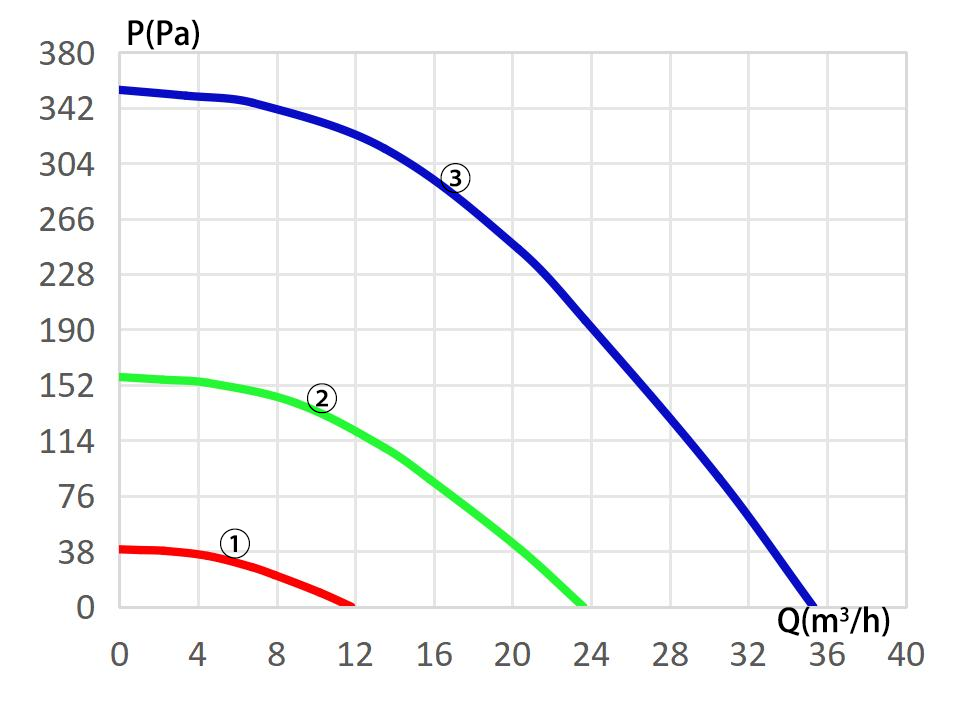
For example, a fan’s maximum airflow may represent free-air performance. Once installed in an enclosure with filters, grilles, heat sinks, or ducts, the actual airflow can be lower because of system resistance.
Before approving a quotation, confirm:
- Whether the stated airflow is free-air airflow or measured at a specified pressure
- Whether a P-Q performance curve is available
- The voltage and operating conditions used for the stated performance
- Any required noise or power limits
- The acceptance criteria for customized performance
If your equipment requires a specific operating point, communicate that requirement explicitly.
This helps both parties evaluate the proposed fan based on its intended application instead of comparing headline figures that may have been measured under different conditions.
3. Confirm the Full Configuration and Scope of Supply
A quoted fan may not automatically include every accessory or interface required by your equipment.
Depending on the project, confirm whether the following items are included:
- Connector and cable assembly
- Specified cable length and pin assignment
- PWM speed control or tachometer output
- Alarm signal or other monitoring functions
- Mounting hardware or accessories
- Special labels, packaging, or identification
- Required technical documents
For example, if your equipment uses a particular connector, confirm the connector model and wiring before production begins. A physically compatible fan may still be unsuitable if its pin assignment differs from your system.
The objective is to define the complete deliverable, not simply the fan itself.
4. Check Environmental Requirements and Applicable Tests
Environmental requirements should be agreed upon before the order is finalized, especially for outdoor, marine, vehicle-mounted, or other demanding applications.
Confirm the required operating temperature, humidity exposure, dust and water protection, corrosion resistance, and vibration conditions where relevant.
If the project specifies a particular standard or qualification test, clarify:
- The applicable test standard and revision, if specified
- Test conditions and duration
- Acceptance criteria
- Whether testing applies to a sample, a production batch, or individual units
- Whether a test report or other documentation is required
Avoid assuming that every available test is included in the quoted price.
Environmental qualification can involve additional engineering work, samples, testing time, and cost. Agreeing on the scope early helps avoid unexpected changes later.
5. Define Sample Approval Before Mass Production
For a new model or customized project, sample approval is an important milestone.
Before testing the sample, agree on what will be evaluated. Depending on the application, this may include dimensions, electrical characteristics, airflow, noise, connector compatibility, and operation in the intended equipment.
A practical sample approval process should answer three questions:
What will be tested?
Identify the parameters and functions that matter to the project.
What constitutes acceptance?
Define measurable requirements wherever possible, rather than relying only on a general statement that the sample is satisfactory.
What happens after approval?
Record the approved model, configuration, drawings, and any agreed deviations so that both parties can refer to the same baseline.
For customized cooling fans, written confirmation is especially useful because a small change in dimensions, wiring, or control behavior can affect integration into the customer’s equipment.
6. Establish Consistency Requirements for Mass Production
A successful sample is a positive start, but the next question is whether production units will follow the same approved requirements.
Before ordering, discuss the supplier’s production quality controls and the inspection requirements applicable to your product.
Useful points to clarify include:
- Which specifications are controlled during production
- Which parameters are checked during final inspection
- Whether inspection is performed on every unit or by sampling
- How nonconforming products are identified and handled
- Whether batch identification or traceability is required
- What inspection records can be provided
The appropriate quality plan depends on the product, project risk, and customer requirements.
For long-term OEM programs, consider documenting the approved specifications and inspection criteria before the first mass-production order. This provides a shared reference for future repeat orders.
7. Confirm Price, MOQ, Lead Time, and Commercial Terms
A competitive unit price is important, but it should be evaluated alongside the complete commercial terms.
Check the following details in the quotation:
| Item | What to confirm |
|---|---|
| Unit price | Exact model and configuration covered |
| MOQ | Minimum order quantity and price breaks |
| Sample cost | Sample price and any applicable development fees |
| Tooling or NRE | Whether special tooling or engineering costs apply |
| Lead time | Sample lead time and mass-production lead time |
| Payment terms | Deposit, balance, and payment conditions |
| Delivery terms | Incoterms, destination, and shipping responsibilities |
| Quotation validity | Expiry date and conditions for price changes |
| Packaging | Standard or customized packaging requirements |
For customized projects, ask whether the quoted price includes the agreed testing, documentation, and accessories.
Lead time should also be defined clearly. Sample development, customer approval, material preparation, and mass production may have different schedules.
A clear quotation makes it easier to compare suppliers on an equivalent basis.
8. Agree on Documentation and Change Control
Industrial cooling fans may become part of a larger equipment platform that remains in production for years. Maintaining consistent specifications can therefore matter well beyond the first order.
Depending on the project, required documentation may include:
- Product datasheet and dimensional drawing
- Electrical connection information
- Performance data or test reports
- Inspection records
- Packaging and labeling specifications
- Approved sample or configuration records
It is also useful to agree on how changes will be communicated.
If a future change affects a component, material, drawing, electrical interface, or other agreed requirement, the buyer should know how the change will be reviewed and approved.
The exact process can be defined according to the project’s quality requirements. The important point is that changes affecting product fit, function, or agreed performance should not be left ambiguous.
A Practical Pre-Order Checklist
Before issuing a purchase order, check whether the following items are clear:
- Exact model and approved technical specifications
- Performance data and test conditions
- Full electrical and mechanical configuration
- Environmental and qualification requirements
- Sample evaluation and acceptance criteria
- Mass-production quality and inspection requirements
- Price, MOQ, lead time, payment, and delivery terms
- Required documentation and change-control arrangements
Not every project needs a complex approval process. A standard replacement fan may require only a few checks, while a customized fan for a new equipment platform may require more detailed technical agreement.
The objective is to match the level of verification to the actual project requirements.
How SenharFans Supports OEM Cooling Fan Projects
SenharFans supplies DC axial fans, DC blower fans, AC axial fans, and customized cooling fan solutions for industrial and electronic equipment applications.
Our capabilities include engineering analysis, prototype development, airflow testing, and environmental testing according to applicable product and project requirements.
For OEM projects, we encourage customers to clarify their application, key specifications, expected quantity, and any special testing or documentation needs during the quotation stage.
This gives both sides a clearer basis for reviewing the proposed solution, confirming the configuration, and planning the next steps.
Whether you are sourcing a standard fan or developing a customized cooling solution, our team can review your requirements and discuss suitable options.
Contact SenharFans
Website: https://senharfans.com/
Email: sales@senharfans.com
WhatsApp: +86-138-1239-0890
Contact us with your technical requirements to discuss a suitable cooling fan solution for your project.
Frequently Asked Questions
Should I approve a cooling fan sample before placing a bulk order?
For a new or customized application, sample evaluation is often a useful way to verify fit, interfaces, and required performance before mass production. The need for sample approval depends on project risk and customer requirements.
What should a cooling fan purchase order include?
It should identify the exact model and configuration, agreed specifications, quantity, price, delivery schedule, payment terms, and any applicable inspection or documentation requirements.
Can I change the fan specifications after approving the sample?
Changes may be possible, but their impact on cost, lead time, compatibility, and validation should be reviewed before implementation. Updated specifications should be confirmed by both parties.
How can I compare quotations from different cooling fan suppliers fairly?
Compare equivalent configurations and technical requirements. Review the performance conditions, accessories, testing scope, MOQ, lead time, commercial terms, and documentation—not just the unit price.
What if my project requires a customized cooling fan?
Provide the application details, available installation space, electrical requirements, performance targets, environmental conditions, and expected quantity. The supplier can then assess feasibility and identify any additional engineering or testing requirements.