Static Pressure vs. Airflow: How to Choose the Right Industrial Cooling Fan
Primary Keyword: static pressure vs airflow
Secondary Keywords: industrial cooling fan, axial fan performance, fan pressure-flow curve, cooling fan selection, OEM cooling fan
Meta Title: Static Pressure vs. Airflow in Industrial Cooling Fans
Meta Description: Understand the difference between static pressure and airflow, how system resistance affects fan performance, and how OEM engineers can select the right industrial cooling fan.
Introduction
When selecting an industrial cooling fan, two specifications often appear at the top of the datasheet: airflow and static pressure.
Both are important, but they describe different aspects of fan performance.
Airflow indicates how much air a fan moves. Static pressure indicates its ability to overcome resistance within an airflow system. Selecting a fan based on only one of these values can lead to poor cooling performance after installation.
This matters in applications such as industrial control cabinets, power electronics, HVAC equipment, communication systems, and marine electronics, where air must pass through grilles, filters, heat sinks, or other restrictive components.
For OEM engineers and equipment designers, the objective is not simply to choose a fan with the highest airflow or pressure rating. It is to find a fan that can deliver the required airflow under the actual operating conditions.
This guide explains the difference between static pressure and airflow, how they interact, and what to consider when selecting an industrial cooling fan.
1. What Is Airflow?
Airflow is the volume of air that passes through a fan over a given period.
Common units include:
- CFM: cubic feet per minute
- m³/h: cubic metres per hour
- L/s: litres per second
Airflow is important because moving air helps carry heat away from electronic components, power modules, motors, and other heat-generating parts.
However, a fan’s airflow depends on the resistance of the system in which it operates.
Free-air airflow
Free-air airflow refers to the airflow measured under conditions with little or no external static pressure.
This value is useful for identifying a fan’s maximum airflow capability under the specified test conditions.
However, most installed cooling systems do not operate under completely unrestricted conditions.
When air must pass through filters, narrow openings, or densely packed components, the delivered airflow changes.
Key takeaway: Maximum airflow is a useful specification, but it should not be treated as the airflow that will automatically be achieved inside your equipment.
2. What Is Static Pressure?
Static pressure describes the pressure a fan develops to move air against resistance in a system.
It is commonly expressed in:
- Pa (pascals)
- mmH₂O (millimetres of water)
- inH₂O (inches of water)
Airflow resistance can come from several sources, including:
- Dust filters
- Protective grilles
- Heat sinks
- Ducts and bends
- Narrow inlet or outlet openings
- Internal partitions and crowded component layouts
As air moves through these restrictions, pressure is lost.
A fan must generate sufficient pressure to overcome the resistance while delivering the required airflow.
Maximum static pressure is not the whole story
A fan datasheet may specify a maximum static pressure measured at or near zero airflow. This is commonly called shut-off pressure.
It does not mean the fan can deliver its maximum airflow at that pressure.
Similarly, a fan’s maximum airflow and maximum static pressure generally represent different operating conditions.
For this reason, engineers should evaluate both specifications together rather than treating them as independent guarantees.
3. Static Pressure vs. Airflow: What Is the Difference?
The difference becomes clearer when the two parameters are compared directly.
| Parameter | Airflow | Static Pressure |
|---|---|---|
| What it describes | Volume of air moved per unit of time | Pressure developed against system resistance |
| Common units | CFM, m³/h, L/s | Pa, mmH₂O, inH₂O |
| Why it matters | Helps determine the available cooling airflow | Helps determine whether airflow can be maintained against resistance |
| Influenced by | Fan design, speed, and system resistance | Fan design, speed, and operating point |
| What to check | Airflow at the required operating point | Pressure capability at the required airflow |
Neither parameter should be considered in isolation.
A fan with a high free-air airflow rating may deliver insufficient airflow through a restrictive system. A fan with a high maximum pressure rating may also be unsuitable if its performance, dimensions, power consumption, or noise do not match the application.
The best choice depends on the complete operating requirement.
4. How System Resistance Affects Fan Performance
Every installed cooling system has its own resistance characteristics.
Consider an electronic control cabinet containing a filter, a protective grille, several heat sinks, and tightly arranged components.
The fan must move air through this complete path.
At a given fan speed, increasing system resistance generally reduces the airflow delivered by the fan. The exact result depends on the fan’s performance curve and the system’s resistance curve.
In many conventional systems, pressure loss increases approximately with the square of airflow over the relevant operating range. Actual systems may behave differently depending on their geometry and components.
This is why fan selection should account for the complete airflow path, not just the fan itself.
A practical example
Suppose an equipment designer needs approximately 100 CFM of airflow through an enclosure.
Two candidate fans have different published maximum airflow values.
Fan A has a higher free-air airflow rating, while Fan B has a lower rating but a different pressure-flow performance curve.
Which one is better?
The maximum airflow figures alone cannot answer the question.
The engineer must compare the available airflow from each fan at the estimated system resistance. If Fan A loses more airflow under the required operating conditions, Fan B could be the more suitable choice.
This is an illustrative example, not a comparison of specific SenharFans products.
5. How to Read a Fan Performance Curve
A pressure-flow curve, commonly called a P-Q curve, shows the relationship between airflow and pressure for a particular fan under specified test conditions.
The horizontal axis typically represents airflow, while the vertical axis represents static pressure.
The curve helps engineers understand how the fan performs as operating conditions change.
To use the curve effectively:
- Identify the required airflow for the equipment.
- Estimate the pressure loss across the complete airflow path.
- Locate the corresponding operating region on the fan performance curve.
- Check whether the fan can deliver the required airflow at the estimated pressure.
- Confirm that power, noise, speed, dimensions, and environmental requirements are also acceptable.
The actual operating point is determined by the interaction between the fan and the system.
If the system resistance has not yet been measured or calculated, the initial selection should be treated as an estimate and validated through testing or further engineering analysis.
For a more detailed explanation, see our related guide on reading an axial fan P-Q curve.
6. How to Choose the Right Fan for Different Applications
Different applications create different airflow and pressure requirements.
Industrial control cabinets
Control cabinets may contain filters, protective grilles, power supplies, drives, and densely arranged electronic components.
The required fan depends on the enclosure layout, heat load, allowable internal temperature, and resistance of the airflow path.
For these applications, engineers should evaluate airflow at the expected operating pressure rather than relying only on free-air ratings.
HVAC equipment
HVAC systems may include filters, heat exchangers, ducts, and other airflow components.
These components influence pressure loss and can affect the fan’s operating point.
The appropriate fan should be selected according to the required airflow, system pressure, energy consumption, noise limits, and equipment configuration.
Communication and power electronics
Compact electronic equipment often has limited installation space and concentrated heat sources.
The airflow path may be restricted by heat sinks, circuit boards, or protective structures.
Depending on the design, a conventional axial fan, a higher-pressure axial fan, or a blower may be appropriate.
Marine and other demanding environments
Marine electronics and other demanding applications may require additional consideration of humidity, corrosion exposure, vibration, temperature, and environmental protection.
These requirements are separate from airflow and static pressure, but they are equally important when evaluating overall fan suitability.
A fan that meets the airflow requirement is not automatically suitable for every operating environment.
7. Axial Fan or Blower: Which Should You Consider?
The choice between an axial fan and a blower depends on the system design.
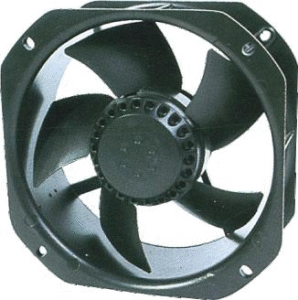
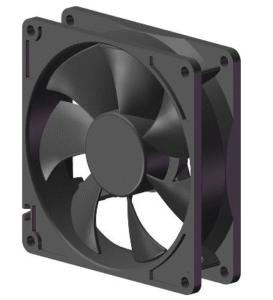
Axial fans
Axial fans move air generally parallel to the fan’s rotational axis.
They are widely used for equipment ventilation and electronic cooling, particularly where a relatively direct airflow path is available.
Depending on the design, some axial fans can also operate against substantial system resistance.
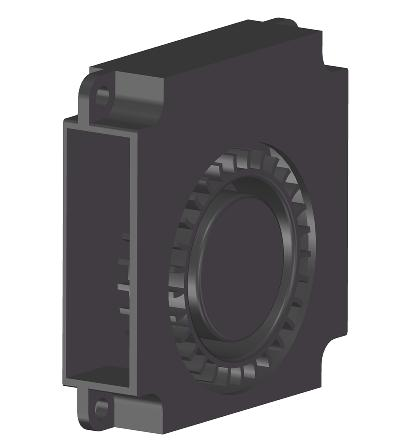
Blower fans
Centrifugal blower fans draw air into the impeller and discharge it in a different direction, typically radially.
They can be useful in compact equipment, ducted airflow paths, and applications requiring a different balance of pressure, airflow, and packaging.
Neither design is universally better.
The correct choice depends on the required operating point, available space, airflow direction, noise constraints, power budget, and other application requirements.
8. What OEM Buyers Should Provide When Requesting a Quote
A quotation request that includes only fan dimensions and voltage may not provide enough information for an accurate engineering recommendation.
Where available, provide the following:
- Fan dimensions: Maximum available installation space
- Voltage: Required supply voltage and acceptable range
- Airflow: Required airflow and how it was determined
- Static pressure: Estimated system resistance, if available
- Heat load: Heat generated by the equipment
- Operating environment: Temperature, humidity, dust, moisture, or salt exposure
- Noise requirements: Maximum acceptable noise level, if specified
- Control functions: PWM, speed feedback, alarm output, or other requirements
- Quantity: Prototype, sample, pilot production, or mass-production demand
If static pressure is unknown, provide the enclosure design, filter details, heat sinks, inlet and outlet arrangement, and any existing fan performance data.
These details help the manufacturer understand the application and determine whether further measurements or testing are needed.
9. How SenharFans Supports Fan Selection
SenharFans supplies DC axial fans, DC blower fans, AC axial fans, and customized cooling solutions for industrial and electronic equipment.
For OEM projects, fan selection can consider the required airflow, static pressure, dimensions, voltage, power consumption, control functions, and operating environment.
Where a standard product does not meet the application requirements, customized options may be evaluated according to the project specifications and engineering feasibility.
The objective is to identify a suitable fan for the actual application rather than selecting a product based on one headline specification.
Conclusion
Airflow and static pressure describe different but closely related aspects of cooling fan performance.
Airflow indicates how much air a fan moves, while static pressure helps explain its ability to overcome resistance in the system.
For industrial cooling applications, neither maximum airflow nor maximum static pressure alone is enough to determine whether a fan is suitable.
The key question is: Can the fan deliver the required airflow at the pressure imposed by the actual system?
By reviewing the pressure-flow curve, understanding the airflow path, and defining the application’s electrical and environmental requirements, OEM engineers can make more informed fan selections.
Need Help Selecting an Industrial Cooling Fan?
If you are developing equipment or sourcing cooling fans for an OEM project, SenharFans can discuss your requirements for standard or customized fan solutions.
Share your fan dimensions, voltage, required airflow, estimated system resistance, application, and operating conditions to help us understand your project.
Website: https://senharfans.com/
Email: sales@senharfans.com
WhatsApp: +86-138-1239-0890