From Prototype to Mass Production: How Customized Cooling Fans Are Developed
Primary Keyword: customized cooling fans
Secondary Keywords: OEM cooling fan manufacturer, custom cooling fan solutions, cooling fan prototyping, industrial fan manufacturer, OEM cooling fan development
Meta Title: Customized Cooling Fans: From Prototype to Mass Production
Meta Description: Learn how customized cooling fans are developed, from defining airflow and electrical requirements to prototype evaluation, testing, and mass production for OEM equipment.
Introduction
Standard cooling fans are suitable for many industrial applications. However, some equipment requires a specific combination of airflow, static pressure, dimensions, voltage, control functions, or environmental performance that a standard model may not fully provide.
For OEM manufacturers, this creates an important engineering question: should you adapt your equipment to an existing fan, or work with a manufacturer to develop a customized cooling solution?
The answer depends on the application, technical requirements, development budget, and production volume.
A well-managed customization process helps both parties clarify requirements, evaluate feasibility, verify performance, and prepare the product for repeatable manufacturing.
In this article, we explain the main stages of customized cooling fan development and what OEM buyers should prepare before contacting a manufacturer.
1. Start with the Application, Not Just the Fan Dimensions
A common starting point for a customization request is a drawing or an existing fan model. These are useful references, but they may not provide enough information to define the complete requirement.
Before development begins, the manufacturer needs to understand how the fan will be used.
Important questions include:
- What equipment will the fan cool?
- How much airflow is required?
- Is the system resistance known or estimated?
- What supply voltage is available?
- What are the maximum allowable dimensions?
- What operating temperature range is required?
- Will the fan be exposed to dust, moisture, salt atmosphere, or vibration?
- Are PWM speed control, tachometer feedback, or alarm signals needed?
- What are the target cost and expected annual quantity?
These details help establish the initial design requirements.
For example, a compact electronic enclosure may prioritize installation space and airflow distribution, while an outdoor industrial system may require additional environmental protection.
The better the initial requirements are defined, the easier it is to evaluate suitable design options and avoid unnecessary development work.
2. Evaluate Whether a Standard Fan Can Meet the Requirements
Customization does not always mean developing a completely new product.
In many projects, an existing fan can provide a useful starting point.
The manufacturer may evaluate whether adjustments to available specifications or configurations can meet the application’s needs.
Depending on the product platform, possible options may include:
- Voltage configuration
- Fan speed and performance selection
- Connector and wiring arrangements
- PWM control or monitoring signals
- Mounting and mechanical integration
- Environmental protection options
The feasibility of each option depends on the existing design and the customer’s requirements.
If a standard model can meet the required performance and integration constraints, it may reduce development time and cost.
If important requirements cannot be satisfied by the existing product range, further engineering or a more extensive customization project may be necessary.
For OEM buyers, it is worth discussing both approaches before committing to a new design.
3. Define the Performance and Interface Requirements
Once the initial direction is established, the next step is to define the key technical parameters.
Airflow and static pressure
The required airflow should be considered together with the resistance of the complete cooling system.
A fan’s free-air airflow rating alone cannot confirm whether it will deliver the required airflow after installation.
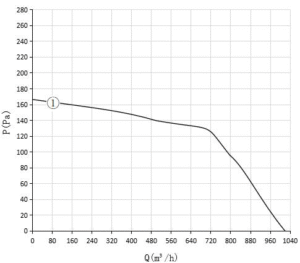
Where available, performance curves and application data can help determine whether the proposed fan is suitable.
Electrical requirements
The manufacturer needs to understand the supply voltage, allowable power consumption, connection method, and any required control or monitoring functions.
These details are particularly important when the fan must integrate with an existing electronic control system.
Mechanical requirements
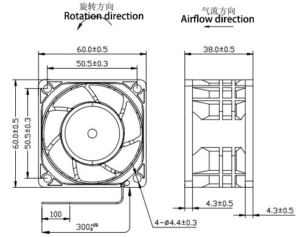
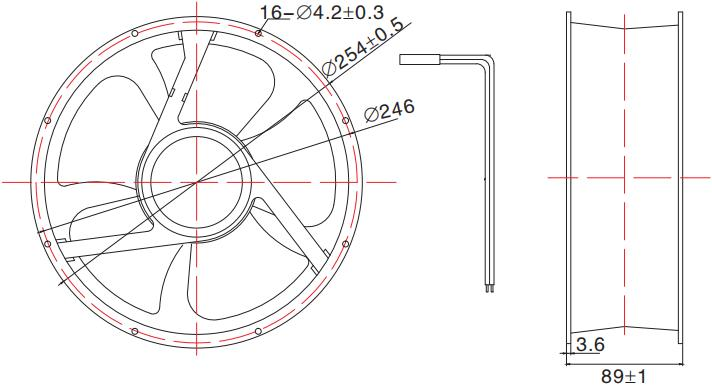
The available installation space, mounting points, airflow direction, cable routing, and connector clearance should be confirmed.
Even a fan with suitable airflow may be unsuitable if it cannot be installed correctly.
Environmental requirements
Temperature, humidity, dust, moisture, corrosion exposure, and vibration should be considered according to the intended operating environment.
Where specific standards or qualification tests are required, these should be identified early rather than introduced after the design has been finalized.
4. Prototype Development and Engineering Evaluation
After the requirements have been reviewed, the project may proceed to prototype development if necessary.
The purpose of a prototype is to evaluate whether the proposed design can meet the defined requirements before committing to production tooling, larger quantities, or a production release.
Depending on the project, development activities may include:
- Mechanical design review
- Airflow and thermal analysis
- Electrical configuration review
- Prototype fabrication or assembly
- Fit and installation checks
- Initial performance measurements
Engineering tools such as 3D modelling, simulation, and rapid prototyping can help identify potential issues earlier in the process.
However, simulation and prototype evaluation serve different purposes.
Simulation can help assess design options under defined assumptions. Physical testing is needed to verify actual prototype performance under the relevant test conditions.
Neither should be treated as a substitute for clearly defined acceptance criteria.
The objective of prototype development is to identify and resolve important design issues before mass production.
5. Test the Prototype Against the Agreed Requirements
Once a prototype is available, it should be evaluated against the requirements established at the beginning of the project.
The appropriate test plan depends on the fan design and intended application.
| Evaluation area | What to verify |
|---|---|
| Airflow and pressure | Whether the fan meets the specified operating requirements |
| Electrical performance | Whether voltage, current, power, and control functions meet the specification |
| Mechanical integration | Whether dimensions, mounting, connectors, and airflow direction are suitable |
| Noise and vibration | Whether performance meets the agreed criteria |
| Temperature | Whether operation is suitable for the specified temperature range |
| Environmental resistance | Whether required environmental tests have been completed successfully |
| Documentation | Whether drawings, specifications, and test records are consistent with the approved design |
Not every project requires every test listed above.
For example, an indoor industrial fan may have different qualification requirements from a fan intended for a marine or airborne application.
The manufacturer and customer should agree on the applicable tests, sample quantities, test conditions, and acceptance criteria.
If the prototype does not meet the requirements, the design may need to be revised and evaluated again.
This feedback process is a normal part of engineering development.
6. Design for Manufacturability
A design that works as a prototype is not automatically ready for high-volume production.
Before mass production, the manufacturer should consider whether the product can be manufactured consistently using the intended production processes.
Depending on the product, this may involve reviewing:
- Component availability
- Assembly procedures
- Manufacturing tolerances
- Rotor balance and mechanical consistency
- Electrical connection methods
- Inspection requirements
- Test equipment and production capacity
- Packaging and identification requirements
Design-for-manufacturing considerations help identify potential cost, quality, and supply issues before they affect larger production quantities.
For OEM buyers, this stage is also an opportunity to confirm the final specification and identify any changes from the approved prototype.
A documented design baseline helps reduce misunderstandings between engineering, purchasing, quality, and production teams.
7. Pilot Production and Quality Planning
Where the project size and risk justify it, a pilot production run can provide a useful bridge between prototype development and full production.
The purpose is to evaluate the manufacturing process using a more representative production workflow.
Depending on the project, the pilot stage may help assess:
- Assembly consistency
- Production cycle time
- Inspection procedures
- Product performance consistency
- Packaging requirements
- Traceability and batch identification
- Potential manufacturing bottlenecks
The customer and manufacturer should also agree on how changes will be managed after the design is approved.
For example, a change to a component, connector, material, or control function may affect compatibility or performance. The impact should be evaluated according to the significance of the change and the agreed quality process.
Not every order requires a formal pilot production stage, but for new or technically demanding OEM products, it can help reduce uncertainty before scaling up.
8. Prepare for Mass Production and Long-Term Supply
After the design and production process have been approved, the project can move toward mass production.
At this stage, the focus shifts from developing the product to manufacturing it consistently and delivering it according to the agreed requirements.
Important considerations include:
Approved specifications
The final product configuration, drawings, performance requirements, and acceptance criteria should be clearly documented.
Production planning
The manufacturer should review the order quantity, material availability, production capacity, and delivery schedule.
Quality control
Inspection and testing should follow the agreed quality plan. The scope of routine checks and any batch-based testing should be clear.
Change management
Any material or design changes should be handled through an appropriate review and approval process.
Ongoing communication
Forecasts, order schedules, technical questions, and quality feedback should be communicated clearly between the customer and manufacturer.
For OEM customers, these arrangements are particularly important when the cooling fan becomes part of a product that will remain in production for several years.
9. What OEM Buyers Should Prepare Before Contacting a Manufacturer
A structured inquiry can make the initial technical discussion more efficient.
Where available, prepare the following information:
- Application: Equipment type and intended operating environment
- Dimensions: Required frame size, thickness, mounting arrangement, or drawing
- Electrical requirements: Voltage, power limitations, wiring, and control functions
- Performance: Required airflow and estimated system resistance
- Environmental conditions: Temperature, humidity, dust, water, corrosion, or vibration requirements
- Quantity: Prototype quantity, initial order quantity, and estimated annual demand
- Timeline: Desired prototype and production schedule
- Quality requirements: Applicable standards, inspection criteria, and required test reports
- Commercial target: Target cost or budget, if available
If you are replacing an existing fan, its model number, datasheet, photographs, and installation dimensions can also be useful.
If some technical details are not yet available, that is not necessarily a barrier to an initial discussion. Clearly identifying what is known and what still needs to be evaluated helps establish the next steps.
10. How SenharFans Supports OEM Cooling Fan Projects
SenharFans supplies DC axial fans, DC blower fans, AC axial fans, and customized cooling solutions for industrial and electronic equipment applications.
The company’s stated engineering capabilities include 3D design, airflow simulation, rapid prototyping, and testing resources for evaluating fan performance and environmental requirements.
Depending on the project, customization discussions may cover:
- Airflow and static pressure requirements
- Dimensions and mounting arrangements
- Voltage and electrical characteristics
- Speed control and monitoring functions
- Environmental requirements
- Product verification and production planning
The appropriate development route depends on the technical requirements, product feasibility, target quantity, and expected cost.
For some projects, selecting an existing model may be the most practical solution. For others, additional engineering and prototype evaluation may be necessary.
The first step is to understand the equipment and define the requirements before recommending a development approach.
Conclusion
Developing a customized cooling fan is not simply a matter of changing dimensions or adjusting speed.
It is a process that connects application requirements, engineering design, prototype evaluation, manufacturing preparation, quality planning, and production delivery.
For OEM buyers, involving the manufacturer early and defining the technical requirements clearly can help reduce avoidable design changes and improve coordination before mass production.
The best development approach is the one that meets the actual application requirements while balancing performance, integration, quality, cost, and production feasibility.
Discuss Your OEM Cooling Fan Project with SenharFans
Are you developing new equipment or looking for a customized alternative to a standard cooling fan?
Send us your application details, drawings or existing fan model, voltage requirements, airflow targets, operating environment, and estimated quantity.
Our team can review the information and discuss potential standard or customized cooling fan options.
Website: https://senharfans.com/
Email: sales@senharfans.com
WhatsApp: +86-138-1239-0890