How to Improve Cooling Efficiency Without Increasing Fan Size
Introduction
In industrial equipment and electronic systems, installation space is often limited. Increasing the cooling fan size may require changes to the enclosure, mounting structure, or overall equipment design.
However, insufficient cooling does not always mean that a larger fan is necessary.
In many cases, cooling performance can be improved by optimizing the airflow path, reducing unnecessary resistance, improving air distribution, and making better use of the existing fan.
This guide explores practical ways to improve cooling performance without increasing the fan’s physical dimensions.
1. Identify Airflow Blockages and Short-Circuit Paths
A cooling fan can generate airflow, but that does not guarantee that the air reaches the components that need cooling.
Inside an enclosure, air may encounter:
- Structural supports and partitions
- Cable bundles and wiring harnesses
- Heat sinks and densely arranged components
- Narrow ventilation openings
- Poorly positioned inlet and outlet vents
Another common problem is airflow short-circuiting. This occurs when incoming cool air travels directly toward the exhaust without passing through the main heat-generating areas.
How to improve it:
- Keep the main airflow channels as clear as possible.
- Position air inlets and outlets to encourage airflow across heat-generating components.
- Use suitable baffles or airflow guides to direct air toward critical areas.
- Prevent incoming air from bypassing the components that require cooling.
- Check whether internal partitions are creating stagnant zones.
The objective is not simply to move more air into the enclosure, but to make better use of the available airflow.
2. Reduce Unnecessary Airflow Resistance
Every component in the airflow path can introduce resistance.
Common sources include:
- Dust filters
- Protective grilles
- Narrow ventilation openings
- Ducts and sharp bends
- Heat sinks and densely packed assemblies
When system resistance increases, the actual airflow delivered by a fan generally decreases.
This means that a fan may have a high free-air airflow rating but deliver considerably less airflow after installation.
How to improve it:
- Select filters with suitable airflow characteristics.
- Clean or replace filters according to maintenance requirements.
- Avoid unnecessarily restrictive grilles and ventilation openings.
- Reduce sharp changes in airflow direction where practical.
- Check whether ducts and ventilation channels are appropriately sized.
- Review whether internal structures are obstructing the fan inlet or outlet.
Reducing unnecessary resistance can help the existing fan operate under more favorable conditions.
For a deeper explanation, read:
Why Static Pressure Matters When Selecting an Axial Fan for Industrial Cooling
3. Optimize Air Inlet and Outlet Positions
The location of air inlets and outlets has a direct influence on how air moves through an enclosure.
Poor positioning can create uneven airflow, stagnant areas, or recirculation of heated air.
For example, if the exhaust is positioned too close to the air inlet, some of the incoming cool air may leave the enclosure before reaching the main heat sources.
How to improve it:
- Position the inlet and outlet according to the internal heat-source layout.
- Ensure that the airflow passes through the areas requiring cooling.
- Avoid placing the inlet and exhaust where they encourage direct airflow bypass.
- Consider the effect of nearby walls, adjacent equipment, and installation clearances.
- Evaluate whether hot exhaust air could be drawn back into the inlet.
In some naturally ventilated systems, lower inlets and higher outlets can take advantage of buoyancy-driven airflow. However, this arrangement should not be treated as a universal rule for forced-air cooling systems.
The final layout should be based on the actual equipment configuration and airflow direction.
4. Improve Internal Component Layout and Heat Distribution
Even when the total airflow is sufficient, some components may still experience high temperatures because air is not distributed evenly.
This is particularly common in compact electronic equipment containing power supplies, processors, drives, heat sinks, and other concentrated heat sources.
How to improve it:
- Avoid placing large components directly in front of critical airflow passages.
- Provide sufficient clearance around heat sinks.
- Direct airflow toward components with higher heat dissipation requirements.
- Separate hot exhaust regions from cool air intake paths.
- Consider baffles or local airflow guides where necessary.
- Review whether heat-generating components can be repositioned.
For components with concentrated heat loads, improving local airflow may be more effective than increasing the total enclosure airflow alone.
Thermal management should consider both the amount of air supplied and how effectively that air reaches each heat source.
5. Evaluate Fan Performance and Speed Settings
Not all fans of the same physical size provide the same airflow and static pressure.
Differences in impeller design, motor characteristics, rotational speed, and overall construction can result in different performance curves.
If the existing fan does not provide sufficient airflow under the actual system resistance, selecting a more suitable fan within the same dimensional envelope may improve cooling performance.
Fan speed adjustment may also be an option when the motor and control system support it.
How to improve it:
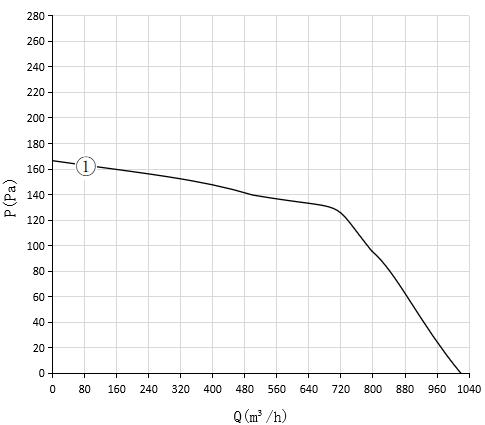
- Compare the P-Q curves of candidate fans with the same installation dimensions.
- Check airflow at the expected system resistance, not only maximum free-air airflow.
- Evaluate whether a higher-performance model is available in the same size.
- Consider PWM or other supported speed-control functions where applicable.
- Confirm voltage, current, power consumption, noise, and temperature limits before changing speed.
Increasing fan speed may improve airflow, but it can also increase noise, power consumption, and mechanical loading. The actual result depends on the fan and system design.
For this reason, fan performance should be evaluated as part of the complete cooling system.
6. Evaluate Multiple-Fan Configurations Carefully
When one fan cannot provide the required cooling performance, using multiple fans may be considered without increasing the size of each individual fan.
However, adding more fans does not automatically produce a proportional increase in airflow.
Two common configurations are:
Fans in series
Fans arranged in series can increase the pressure capability of a fan assembly under suitable conditions. This may be useful when the system has relatively high airflow resistance.
Fans in parallel
Fans arranged in parallel can increase the available airflow capacity under suitable conditions. However, the actual airflow depends on the combined fan performance and system resistance.
The result also depends on fan spacing, alignment, flow interaction, and the enclosure layout.
How to improve it:
- Evaluate the combined performance using appropriate fan curves.
- Ensure that the fans are compatible in terms of size and operating characteristics.
- Check whether the enclosure can distribute the combined airflow effectively.
- Consider the additional electrical load, noise, wiring, and installation requirements.
- Validate the final configuration through testing.
A multi-fan arrangement should be treated as an engineered system configuration rather than a simple way to multiply airflow.
7. Validate Cooling Improvements Through Testing
Airflow optimization should be verified under realistic operating conditions.
A design change that improves airflow in one area may create a new hot spot elsewhere. Similarly, a higher fan speed may improve one component’s temperature while increasing noise or power consumption.
A practical validation process should include:
- Record the initial operating temperatures of critical components.
- Measure or evaluate airflow under the existing configuration.
- Identify the main airflow restrictions and potential bypass paths.
- Implement one design improvement at a time where practical.
- Repeat temperature and airflow measurements under comparable operating conditions.
- Check noise, power consumption, and operating stability.
For more demanding applications, airflow visualization, thermal imaging, or computational fluid dynamics (CFD) analysis may help identify uneven airflow distribution and localized hot spots.
The final design should be evaluated under representative ambient temperatures and operating loads.
Why Cooling Optimization Matters
Improving cooling performance without increasing fan size can offer several practical benefits:
- Maintain the existing equipment dimensions.
- Reduce the need for mechanical redesign.
- Improve airflow distribution across critical components.
- Make better use of the installed fan.
- Potentially reduce unnecessary energy consumption or noise when the system is optimized appropriately.
- Support more effective thermal management.
The actual benefits depend on the equipment configuration and should be verified through engineering evaluation.
How SenharFans Supports Compact Cooling Applications
SenharFans, manufactured by Jiangsu Shenghang Electronic Technology Co., Ltd., provides AC axial fans, DC axial fans, and DC blower fans for industrial and electronic equipment.
For applications with limited installation space, fan selection involves more than matching external dimensions. Airflow, static pressure, voltage, power consumption, noise, operating temperature, and installation conditions all need to be considered.
The company operates under the GJB9001C-2017 quality management system and holds a Level-II confidentiality qualification. Our products are developed and manufactured within this quality management framework.
Our testing capabilities include airflow, acoustic, salt spray, high- and low-temperature, damp heat, thermal shock, and vibration testing to support product evaluation according to applicable project requirements.
For OEM projects, we can discuss suitable standard fan models and customization options based on the equipment’s technical requirements and available installation space.
Conclusion
Increasing fan size is not the only way to improve cooling performance.
In many industrial and electronic systems, optimizing the airflow path, reducing unnecessary resistance, improving component layout, and selecting a more suitable fan can help improve cooling within the existing installation space.
The most effective approach is to evaluate the complete cooling system rather than focusing on the fan alone.
By combining appropriate fan selection with sound airflow design and practical testing, equipment manufacturers can achieve more effective thermal management without necessarily changing the fan’s physical dimensions.
Need Help Optimizing Your Cooling System?
If your equipment has limited installation space or requires improved cooling performance, SenharFans can help evaluate your application requirements.
Send us your existing fan specifications, installation dimensions, airflow requirements, operating voltage, and application conditions.
Our team can help assess suitable AC axial fans, DC axial fans, and DC blower solutions for your project.
Email: sales@senharfans.com
Phone / WeChat / WhatsApp: +86-138-1239-0890
SenharFans – Cooling Solutions for Industrial and Electronic Applications.