Top 5 Mistakes When Choosing a Cooling Fan (And How to Avoid Them)
Introduction
Choosing a cooling fan for industrial equipment is not simply a matter of comparing dimensions, voltage, or maximum airflow.
A fan that looks suitable on a datasheet may perform differently after installation. Airflow restrictions, operating conditions, electrical compatibility, and mechanical integration can all affect the final result.
For engineers, OEM manufacturers, and industrial equipment buyers, understanding these potential problems before purchasing can help avoid unnecessary costs, inadequate cooling, and repeated product changes.
Here are five common mistakes to avoid when selecting an industrial cooling fan.
Mistake 1: Selecting a Fan Based Only on Maximum Airflow
One of the most common mistakes is choosing a fan simply because it has a higher CFM or m³/h rating.
Maximum airflow is generally measured under free-air conditions, where external resistance is very low. In an actual installation, air may need to pass through filters, protective grilles, heat sinks, ducts, and internal components.
These restrictions reduce the airflow a fan can deliver.
How to avoid it:
Start by determining the cooling airflow required by the equipment. Then evaluate the fan’s airflow at the expected system resistance.
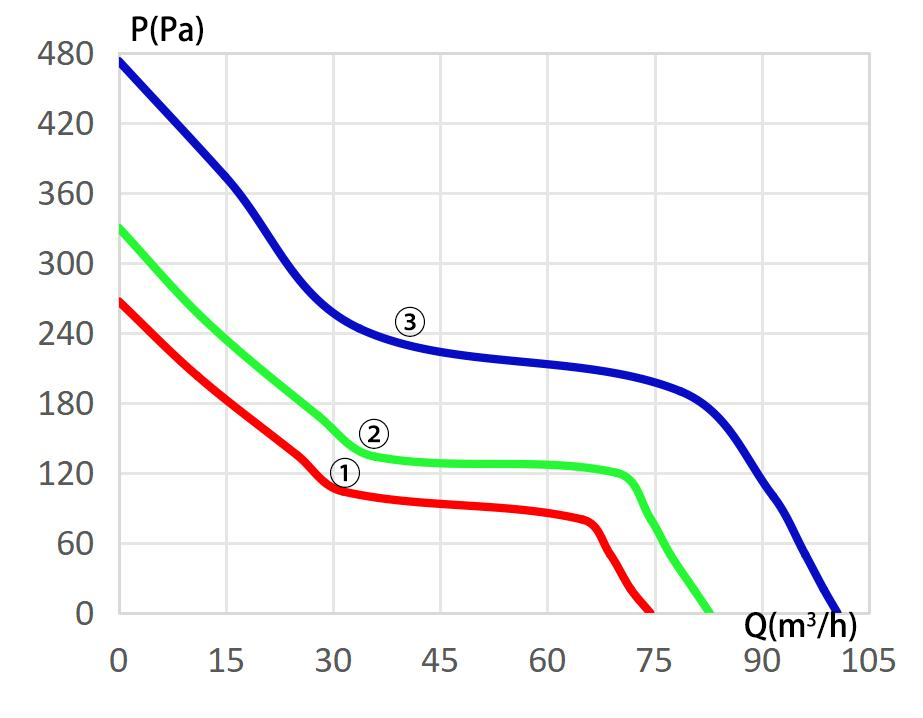
Do not compare fans using maximum airflow alone. Request the manufacturer’s pressure-flow performance curve, also known as the P-Q curve, and check the expected operating point.
For a more detailed explanation, read our guide:
How to Read an Axial Fan P-Q Curve
Mistake 2: Confusing Maximum Static Pressure with Actual Operating Performance
Airflow and static pressure are closely related, but they describe different aspects of fan performance.
A fan’s maximum airflow and maximum static pressure are generally measured at different operating conditions. They should not be treated as performance values available simultaneously.
For example, a fan with a high maximum static pressure rating does not necessarily deliver sufficient airflow at the pressure required by the application.
How to avoid it:
Evaluate airflow and pressure together.
Consider the complete airflow path, including:
- Air filters and protective grilles
- Heat sinks and electronic components
- Ducts and ventilation channels
- Inlet and outlet openings
- Internal partitions and installation restrictions
The objective is to identify a fan that can provide the required airflow under the actual operating conditions.
Read more: Why Static Pressure Matters When Selecting an Axial Fan for Industrial Cooling
Mistake 3: Choosing the Wrong Fan Type for the Airflow Path
Different fan designs serve different airflow requirements.
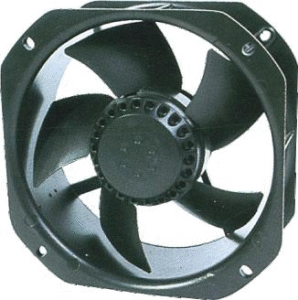
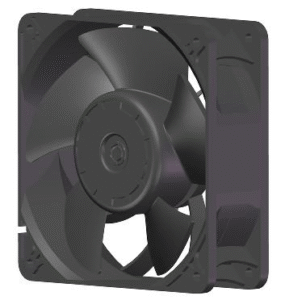
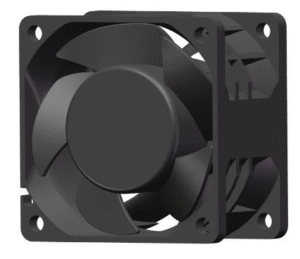
Axial fans move air generally parallel to the rotational axis. They are commonly used for direct ventilation and cooling where air can flow through the equipment along a relatively straight path.
Centrifugal fans draw air into the impeller region and discharge it radially. They can be suitable for applications requiring a change in airflow direction or where the system presents greater resistance.
Compact DC blowers are also used in electronic and industrial cooling systems where directed airflow and installation space are important.
However, fan type alone does not determine suitability. Actual performance depends on the fan design, operating speed, pressure-flow characteristics, and system configuration.
How to avoid it:
Before selecting a fan, understand:
- The required airflow direction
- Available inlet and outlet space
- System resistance
- Required airflow and pressure
- Installation dimensions
Compare the performance data of suitable fan models instead of assuming that one fan type is always better.
Related guide: Axial Fan vs Centrifugal Fan: Key Differences
Mistake 4: Overlooking Installation and Environmental Conditions
A cooling fan does not operate independently of the equipment in which it is installed.
Even a fan with suitable catalogue specifications may not perform as expected if its installation conditions are overlooked.
Important factors include:
Installation conditions
- Available mounting dimensions
- Inlet and outlet clearance
- Airflow direction and ventilation layout
- Nearby obstructions
- Mounting method and mechanical compatibility
Operating environment
- Ambient temperature
- Dust and moisture exposure
- Humidity and condensation
- Salt atmosphere in marine environments
- Vibration and mechanical shock, where applicable
These conditions should be considered during the initial selection process, particularly for industrial, outdoor, marine, and specialized electronic equipment.
How to avoid it:
Define the actual operating environment before selecting a fan.
Check the model-specific operating temperature range, construction materials, protection characteristics, and available environmental test data. If the equipment has special vibration, shock, or corrosion-resistance requirements, confirm that the selected model has the relevant supporting documentation.
Do not assume that every fan in the same product category has identical environmental capabilities.
Mistake 5: Judging Reliability by Price or Bearing Type Alone
Choosing the cheapest fan may reduce the initial purchasing cost, but it does not necessarily provide the best overall value.
At the same time, selecting a fan based only on its bearing type or a claimed service-life figure can also lead to an incorrect decision.
Fan reliability depends on several factors, including:
- Bearing configuration and quality
- Motor and electrical design
- Operating temperature
- Rotational speed and operating conditions
- Mechanical installation
- Manufacturing consistency
- Relevant product test data
For example, a dual ball bearing configuration may be suitable for certain operating requirements, but bearing type alone cannot establish the service life of a complete fan.
How to avoid it:
Evaluate reliability using product-specific technical information.
Ask the manufacturer about:
- Bearing configuration
- Rated operating temperature
- Published service-life data and its test conditions
- Available environmental test results
- Quality management and production controls
- Product consistency and customization capabilities
Compare the total application cost, including installation, maintenance, replacement, and potential downtime, rather than focusing only on the initial unit price.
A Practical Checklist Before Ordering a Cooling Fan
Before finalizing a fan selection, engineers and purchasing teams should confirm the following information.
| Selection Item | Information to Confirm |
|---|---|
| Fan type | AC axial, DC axial, or DC blower |
| Dimensions | Required fan size and mounting arrangement |
| Voltage | Rated voltage and acceptable operating range |
| Airflow | Required airflow under the intended operating conditions |
| Static pressure | Estimated system resistance and required operating point |
| Power | Rated power consumption |
| Noise | Acceptable noise level and measurement conditions |
| Bearings | Bearing configuration and application requirements |
| Environment | Temperature, humidity, dust, moisture, salt, vibration, and shock requirements |
| Additional functions | PWM, tachometer, alarm, or other control requirements, if needed |
Providing this information to the fan manufacturer makes technical evaluation more efficient and helps identify suitable standard or customized solutions.
How SenharFans Supports Industrial Cooling Fan Selection
SenharFans, manufactured by Jiangsu Shenghang Electronic Technology Co., Ltd., provides AC axial fans, DC axial fans, and DC blower fans for industrial and electronic equipment.
Our product selection and engineering support consider application requirements such as airflow, static pressure, dimensions, voltage, power consumption, noise, and operating environment.
The company operates under the GJB9001C-2017 quality management system and holds a Level-II confidentiality qualification. Our products are developed and manufactured within this quality management framework.
Our testing capabilities include airflow, acoustic, salt spray, high- and low-temperature, damp heat, thermal shock, and vibration testing, supporting product evaluation according to applicable project requirements.
For OEM projects, we can discuss standard products and customization options based on the equipment’s technical specifications.
Conclusion
Choosing the right cooling fan requires more than comparing a few numbers on a product datasheet.
The five mistakes discussed in this article can lead to inadequate cooling, integration problems, unnecessary costs, and avoidable maintenance.
By evaluating the actual airflow requirement, system resistance, fan type, installation environment, and product reliability, engineers and buyers can make better-informed decisions.
A suitable cooling fan should match the complete application—not just one specification.
Need Help Selecting an Industrial Cooling Fan?
Whether you need an AC axial fan, DC axial fan, or DC blower, SenharFans can help evaluate your application requirements.
Contact our team to discuss your project.
Email: sales@senharfans.com
Phone / WeChat / WhatsApp: +86-138-1239-0890
SenharFans – Cooling Solutions for Industrial and Electronic Applications.