Why Static Pressure Matters When Selecting an Axial Fan for Industrial Cooling
When selecting a cooling fan for electronic equipment, airflow is often the first specification engineers look at.
A fan may be advertised as delivering 150 CFM, 200 CFM, or even more. However, that number alone does not tell you how much air the fan will actually move after it is installed in a real system.
Filters, grilles, heat sinks, ducts, protective covers, and narrow air passages all create resistance. As resistance increases, the actual airflow of an axial fan decreases.
For industrial cooling, control cabinet cooling, radar cooling, marine ventilation, and other demanding applications, static pressure is therefore just as important as airflow.
Understanding the relationship between airflow and static pressure is one of the most important steps in selecting a suitable cooling fan.
1. What Is Static Pressure?
Static pressure is the pressure capability a fan can generate to overcome resistance within an airflow system.
An axial fan does not operate in completely unrestricted air once it has been installed inside equipment.
For example, an electronic enclosure may contain:
- Air filters
- Protective grilles
- Heat sinks
- Electronic modules
- Cable bundles
- Ventilation channels
- Waterproof structures
Each component restricts airflow to some degree.
The greater the resistance, the more static pressure the fan needs to maintain the required airflow.
This means that two fans with similar free-air CFM ratings may perform very differently once installed in the same equipment.
2. Free-Air Airflow Can Be Misleading
A fan’s maximum airflow is normally measured under conditions with very little resistance.
This is commonly referred to as free-air airflow.
It is useful for comparing products, but it should not be treated as the expected airflow inside an enclosure.
Consider a simplified example.
A cooling fan may have a free-air rating of 200 CFM. After installation, the system includes a filter, grille, heat sink, and other restrictions.
The system resistance increases.
The fan may then operate at a much lower airflow than its catalogue maximum.
If the engineer selects the fan based only on the 200 CFM figure, the electronic equipment may receive insufficient cooling.
This is one reason why a fan’s P-Q curve is so important.
3. Understanding the P-Q Curve
The P-Q curve represents the relationship between airflow and static pressure.
Generally:
Higher airflow → lower available static pressure
Higher static pressure → lower airflow
The actual operating point occurs where the fan performance curve intersects the resistance curve of the complete system.
This operating point provides a much more useful indication of real-world performance than free-air airflow alone.
For an OEM application, engineers should therefore provide the fan supplier with as much information as possible about the airflow path.
Useful information includes:
- Required airflow
- Estimated system resistance
- Filter specifications
- Heat sink arrangement
- Air inlet and outlet dimensions
- Fan installation position
- Operating temperature
With these parameters, the appropriate fan can be selected based on the actual operating condition.
4. Why Filters Can Change Fan Selection
Filters are particularly important in outdoor and industrial equipment.
A filter protects electronic components from dust, dirt, salt particles, and other contaminants. However, it also creates airflow resistance.
A clean filter may have relatively low pressure loss.
As the filter becomes contaminated, resistance increases.
This creates a practical problem:
The fan may still be operating, but the cooling airflow may gradually decrease.
For equipment installed in dusty or harsh environments, the fan should therefore have sufficient pressure capability to maintain useful airflow as filter resistance changes.
This is particularly relevant for:
- Outdoor control cabinets
- Telecom equipment
- Radar shelters
- Industrial power systems
- Solar and energy-storage equipment
- Transportation electronics
The cooling system should be designed for realistic operating conditions rather than an ideal clean-filter condition.
5. Axial Fans for Control Cabinet Cooling
Control cabinets often contain power electronics, PLCs, drives, communication modules, and other heat-generating components.
The available installation space may be limited, making compact axial fans an attractive solution.
However, the enclosure design can create significant airflow resistance.
For effective control cabinet cooling, engineers should consider:
- Heat generation inside the cabinet
- Required temperature rise
- Filter pressure drop
- Grille resistance
- Internal airflow distribution
- Fan operating point
- Ambient temperature
Simply installing a high-CFM fan does not guarantee good cabinet cooling.
The airflow must actually pass through the areas where heat is generated.
In some designs, improving the airflow path can be as important as selecting a larger fan.
6. Radar Cooling Requires a Different Level of Attention
Radar and electronic systems often operate continuously and may contain high-power electronic components in relatively compact spaces.
Thermal management becomes particularly important because excessive temperature can affect system stability, component life, and equipment availability.
For radar cooling, the fan may need to operate against:
- Dense electronic assemblies
- Heat sinks
- Filters
- Protective structures
- Narrow ventilation channels
The fan therefore needs adequate static-pressure capability while maintaining the required airflow.
For demanding applications, fan selection should also consider:
- Operating temperature
- Reliability
- Vibration
- Humidity
- Corrosion protection
- Speed control
- Monitoring functions
This is where a standard commercial cooling fan may not provide the same level of application flexibility as an engineered thermal management solution.
7. Marine Ventilation: Pressure, Corrosion and Reliability
Marine equipment presents additional challenges.
Electronic systems installed on vessels may be exposed to:
- High humidity
- Salt-laden air
- Temperature variation
- Vibration
- Restricted ventilation paths
For marine ventilation and shipboard electronic cooling, the fan must be selected according to both airflow requirements and environmental conditions.
A fan with excellent airflow performance in a laboratory environment may not be suitable for a marine application if its materials, electronics, bearings, or protection system are not designed for the environment.
For this reason, environmental requirements should be discussed with the fan supplier at the beginning of the project.
8. Temperature Also Affects Cooling Performance
Another factor that is sometimes overlooked is ambient temperature.
As air temperature increases, air density decreases.
This means the same volumetric airflow does not necessarily provide the same cooling effect under different environmental conditions.
For equipment operating in hot climates, engineers should therefore consider:
- Maximum ambient temperature
- Internal temperature limit
- Air density
- Fan motor temperature
- Bearing operating conditions
- Required airflow at operating temperature
For outdoor industrial equipment, desert installations, and other high-temperature applications, these factors can have a significant influence on thermal performance.
9. What About EC Fans?
EC fans are increasingly used in HVAC and industrial ventilation because electronically commutated motors can provide efficient operation and convenient speed control.
Depending on the application, an EC fan can offer:
- Variable-speed operation
- Efficient motor performance
- Reduced energy consumption
- Integrated electronic control
- Flexible system integration
However, the same selection principles still apply.
An EC fan should not be selected solely because of its maximum airflow.
The engineer still needs to consider the operating point, static pressure, environmental conditions, noise, reliability, and system requirements.
In applications requiring compact DC power input, a DC axial fan may also be a practical solution.
The best choice depends on the equipment architecture and operating conditions.
10. How to Select the Right Fan: A Practical Approach
When evaluating a cooling fan for an OEM project, we recommend the following process.
Step 1: Determine the heat load
Calculate the heat generated by the equipment under the worst expected operating condition.
Step 2: Determine the required airflow
Establish the required airflow based on the allowable temperature rise.
Step 3: Estimate system resistance
Consider filters, grilles, heat sinks, ducts, and other airflow restrictions.
Step 4: Check the P-Q curve
Find the fan’s expected operating point rather than relying only on free-air CFM.
Step 5: Check environmental conditions
Consider temperature, humidity, dust, salt exposure, vibration, and altitude.
Step 6: Check control requirements
Determine whether PWM, tachometer, alarm, temperature control, or other functions are required.
Step 7: Consider service life
For mission-critical cooling, evaluate bearing design, reliability data, production quality, and expected operating life.
This approach can significantly reduce the risk of selecting a fan that looks suitable on paper but underperforms after installation.
11. SenharFans: From Fan Selection to Thermal Management
SenharFans provides cooling fans and thermal management solutions for industrial and demanding electronic applications.
Our product range includes:
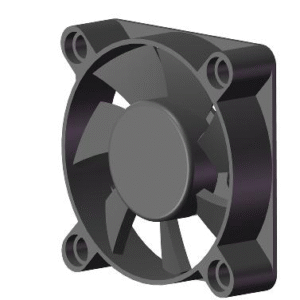
- DC axial fans
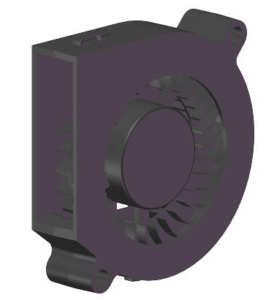
- DC blower fans
- DC condensing fans
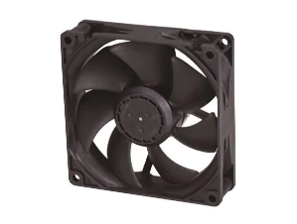
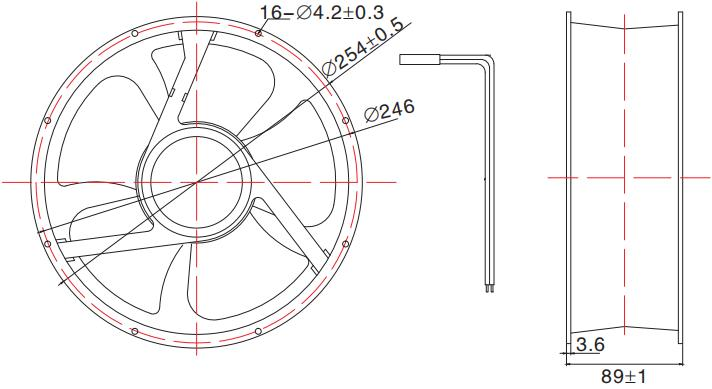
- AC axial fans
Our products can be used in applications such as:
- HVAC systems
- Control cabinet cooling
- Radar cooling
- Marine ventilation
- Naval systems cooling
- Airborne electronics cooling
- Industrial equipment
- Electronic and communication systems
For OEM projects, fan specifications can be developed according to the actual application requirements, including airflow, pressure, voltage, dimensions, speed control, environmental protection, and other technical parameters.
Our objective is not simply to provide a fan with a high catalogue airflow.
The goal is to help customers develop a practical and reliable thermal management solution for their equipment.
12. Questions to Ask Your OEM Fan Supplier
Before placing an order, ask the supplier:
Can you provide the P-Q curve?
What is the airflow at the required static pressure?
What are the operating temperature limits?
What environmental protection is available?
Can the fan support speed control?
Are tachometer or alarm outputs available?
Can the supplier provide samples for evaluation?
Can the fan be customized for an OEM application?
A reliable OEM fan supplier should be able to discuss these technical questions rather than focusing only on catalogue specifications.
Conclusion
For industrial cooling, airflow and static pressure should always be considered together.
A cooling fan that provides excellent free-air airflow may not deliver sufficient airflow once installed behind a filter, inside a cabinet, or within a restricted ventilation system.
For applications such as HVAC systems, control cabinet cooling, radar cooling, marine ventilation, and airborne electronics cooling, understanding the real operating point is essential for achieving reliable thermal performance.
SenharFans works with OEM customers, distributors, system integrators, and equipment manufacturers to provide axial fans, cooling fans, ventilation fans, and customized OEM cooling solutions.
If you are selecting a fan for a new project or looking for a replacement for an existing supplier, send us your requirements.
Please provide the available fan size, voltage, required airflow, static pressure, operating temperature, and application environment.
Our engineering team can help evaluate the appropriate solution for your application.
Looking for a reliable OEM fan supplier or thermal management partner?
Contact SenharFans today.
📧 sales@senharfans.com
🌐 www.senharfans.com
SenharFans — Reliable Thermal Management for Demanding Applications.