How to Select the Right Axial Fan for Electronic Equipment Cooling
When electronic equipment operates continuously, choosing the right cooling fan is more than a matter of airflow. The fan must work together with the enclosure, filter, heat sink, power supply, and control system to provide stable thermal performance under real operating conditions.
For industrial equipment, control cabinets, HVAC systems, radar systems, marine electronics, and other demanding applications, selecting an axial fan based only on its free-air airflow rating can lead to insufficient cooling, excessive noise, or premature failure.
A better approach is to evaluate the complete cooling system and select a fan according to actual airflow demand, static pressure, operating temperature, installation conditions, and expected service life.
SenharFans provides DC axial fans, cooling fans, ventilation fans, and customized thermal management solutions for industrial and mission-critical applications.
1. Start With the Actual Heat Load
The first step in fan selection is understanding how much heat must be removed from the equipment.
Electronic components such as power supplies, processors, inverters, communication modules, and RF equipment convert part of their electrical energy into heat. If this heat cannot be dissipated efficiently, internal temperatures will increase and may affect component performance and service life.
For a forced-air cooling system, the required airflow depends on several factors:
- Total heat dissipation inside the enclosure
- Maximum ambient temperature
- Maximum allowable internal temperature
- Air density
- Heat-transfer efficiency
- Pressure losses caused by filters, grilles, ducts, and heat sinks
A fan with a high free-air CFM rating does not necessarily provide sufficient cooling after installation.
This is why fan selection should begin with the thermal requirements of the complete system rather than the fan catalogue alone.
2. Free-Air Flow Is Not the Same as Working Airflow
One of the most common mistakes when selecting a cooling fan is comparing products only by their maximum airflow.
A typical axial fan specification may state a free-air airflow value such as 100, 150, or 200 CFM. This measurement represents the airflow under very low system resistance.
In an actual installation, air must pass through components such as:
- Protective grilles
- Dust filters
- HEPA filters
- Heat sinks
- Electronic components
- Narrow ventilation channels
- Enclosure openings
All of these create resistance.
As system resistance increases, the actual airflow produced by the fan decreases.
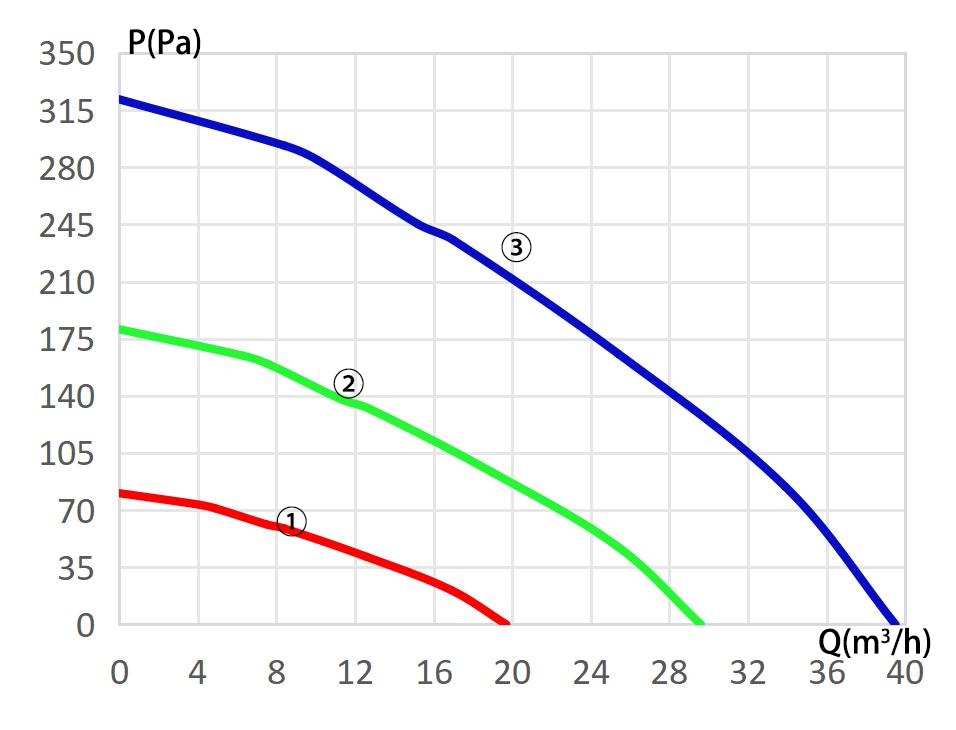
Therefore, engineers should evaluate the P-Q curve, which shows the relationship between airflow and static pressure.
For example, a fan rated at 200 CFM in free air may deliver considerably less airflow when installed behind a filter and grille.
For control cabinet cooling, radar cooling, and other enclosed electronic systems, the operating point of the fan should be considered rather than the free-air airflow alone.
3. Why Static Pressure Matters
Static pressure is particularly important when the cooling system includes filters or restricted airflow paths.
Consider an outdoor electronic cabinet installed in a dusty environment. The cabinet may require an air filter to prevent contamination. As dust accumulates, filter resistance increases.
A cooling fan with insufficient static-pressure capability may continue rotating normally while delivering significantly less airflow.
The result can be an increase in cabinet temperature even though there is no obvious fan failure.
For this reason, a suitable industrial cooling fan should provide sufficient pressure margin for the complete system.
This is especially important for:
- Control cabinet cooling
- Radar cooling
- Telecom equipment
- Industrial power electronics
- HVAC systems
- Marine electronics
- Outdoor electrical enclosures
At SenharFans, fan selection can be based on the required airflow and system resistance rather than simply selecting a model according to its nominal size.
4. Consider the Operating Environment
Temperature is another critical factor.
A fan designed for a normal indoor environment may not be suitable for equipment installed outdoors, inside machinery spaces, or in other demanding environments.
Before selecting an axial fan, consider:
Ambient temperature
Will the fan operate at 25°C, 55°C, or even higher temperatures?
Humidity
Will the equipment be exposed to condensation or high relative humidity?
Dust
Does the installation require protection against airborne particles?
Salt and corrosion
Is the equipment installed near the sea or on a vessel?
Vibration and shock
Will the fan be installed in transportation equipment, marine systems, or airborne electronics?
Altitude
Will reduced air density affect cooling performance?
These environmental factors can significantly influence fan performance and service life.
A reliable thermal management solution should consider the actual installation environment from the beginning of the design process.
5. DC Axial Fans for Flexible Electronic Cooling
DC axial fans are widely used in electronic equipment because they provide a compact solution for moving air through enclosures and heat-generating components.
Depending on the application, DC fans can support functions such as:
- PWM speed control
- Tachometer output
- Locked-rotor detection
- Alarm output
- Temperature-based speed control
Variable-speed operation can also reduce energy consumption and noise when the equipment does not require maximum cooling capacity.
For example, a control cabinet may require high airflow during peak operation but much less airflow during standby conditions.
Instead of running the fan continuously at maximum speed, the cooling system can adjust fan speed according to temperature or system load.
This approach can contribute to:
- Lower energy consumption
- Reduced acoustic noise
- Lower mechanical stress
- Longer operating life
- More efficient thermal management
6. Axial Fan or Blower: Which One Should You Choose?
Axial fans and centrifugal blowers are both widely used for industrial cooling, but they are suitable for different airflow requirements.
An axial fan generally moves air in a direction parallel to the fan shaft. It is often suitable for applications requiring relatively high airflow within a compact installation space.
Typical applications include:
- Electronic enclosure cooling
- HVAC ventilation
- Control cabinet cooling
- Radar equipment cooling
- Marine ventilation
- Industrial equipment ventilation
A centrifugal blower, on the other hand, can be advantageous when the system requires higher static pressure or airflow through a more restrictive duct system.
The correct choice depends on the system resistance and available installation space.
For OEM projects, it is often more effective to evaluate the complete airflow path before deciding between an axial fan and blower.
7. Reliability Matters in Mission-Critical Applications
For some equipment, fan failure is more than a maintenance inconvenience.
A cooling fan failure can cause:
- Excessive component temperature
- Automatic system shutdown
- Reduced equipment availability
- Emergency maintenance
- Potential damage to sensitive electronics
This becomes particularly important in mission-critical cooling applications.
Radar systems, naval electronics, airborne equipment, communication systems, and other critical platforms may need to operate continuously under demanding environmental conditions.
For these applications, engineers should evaluate more than airflow.
Important factors include:
- Bearing design
- Motor reliability
- Electronic protection
- Operating temperature range
- Vibration resistance
- Moisture protection
- Manufacturing consistency
- Quality control
- Expected service life
A high reliability cooling system should be designed around the actual operating requirements of the equipment.
8. What Should OEM Buyers Ask a Fan Supplier?
When purchasing cooling fans for an OEM project, price and nominal airflow should not be the only considerations.
We recommend asking your fan supplier for:
Performance Data
- Airflow versus static pressure curves
- Rated voltage
- Operating voltage range
- Power consumption
- Speed range
- Noise data
Environmental Data
- Operating temperature
- Humidity capability
- IP protection options
- Salt-spray resistance where applicable
- Vibration and shock test information
Reliability Information
- Bearing specifications
- Life calculations or reliability data
- Failure detection functions
- Production testing procedures
Engineering Support
- CAD drawings
- Electrical interface information
- Fan selection assistance
- Sample availability
- OEM customization capability
These documents allow engineers to evaluate whether a fan is actually suitable for their equipment instead of making a decision based only on a catalogue specification.
9. Why Work With an OEM Cooling Solution Supplier?
For standard equipment, an off-the-shelf fan may be sufficient.
However, many industrial and defense-related applications have specific requirements for airflow, dimensions, voltage, speed control, connectors, environmental protection, and installation.
This is where an experienced OEM fan supplier can provide additional value.
SenharFans supports customized cooling solutions according to project requirements, including:
- Fan dimensions
- Voltage
- Airflow
- Static pressure
- Speed control
- Alarm and tachometer functions
- Connector configuration
- Environmental protection
- Noise requirements
- Mechanical interface
Our engineering capabilities cover fan design, performance testing, production, and quality verification.
For customers developing new equipment, we can work from the required operating conditions rather than simply recommending a standard catalogue model.
10. SenharFans: Thermal Management for Demanding Applications
SenharFans is a thermal management brand of Jiangsu Shenghang Electronic Technology Co., Ltd., specializing in cooling fans and thermal solutions for industrial and demanding electronic applications.
Our product range includes:
- DC axial fans
- DC blower fans
- DC condensing fans
- AC axial fans
- Customized fan and motor solutions
Our products are used in applications including:
- HVAC systems
- Control cabinet cooling
- Radar cooling
- Marine ventilation
- Naval systems cooling
- Airborne electronics cooling
- Industrial electronic equipment
- Communication and power equipment
For applications where environmental conditions are demanding, customized options can be considered for temperature resistance, moisture protection, corrosion resistance, speed control, and other requirements.
Our engineering team also works with customers on fan selection and application-specific thermal management.
11. A Practical Fan Selection Checklist
Before selecting your next cooling fan, check the following:
1. What is the total heat load?
Determine how much heat needs to be removed.
2. What airflow is required?
Calculate the required airflow based on the allowable temperature rise.
3. What is the system resistance?
Include filters, grilles, heat sinks, ducts, and other restrictions.
4. What is the actual operating temperature?
Consider both minimum and maximum ambient temperatures.
5. What environmental conditions exist?
Evaluate dust, moisture, salt, vibration, altitude, and other factors.
6. Is speed control required?
PWM, temperature control, or other control methods may improve system efficiency.
7. What reliability level is required?
For mission-critical equipment, consider the complete reliability requirements rather than fan price alone.
8. Does the supplier provide engineering support?
A good supplier should be able to provide technical data and help determine whether the selected fan matches the application.
Conclusion
Selecting an axial fan is not simply a matter of choosing the largest airflow rating available.
A successful cooling system must balance airflow, static pressure, temperature, environmental conditions, noise, reliability, installation space, and service requirements.
For industrial equipment, HVAC systems, control cabinets, radar systems, marine electronics, and airborne equipment, the right fan can become an important part of the overall thermal management solution.
SenharFans provides DC axial fans, cooling fans, ventilation fans, and customized OEM cooling solutions for customers who require reliable airflow and long-term operating performance.
If you are developing new equipment, replacing an existing fan, or looking for an alternative to your current supplier, our engineering team can evaluate your requirements and recommend a suitable solution.
Looking for a reliable OEM fan supplier?
Send us your required airflow, static pressure, voltage, dimensions, operating temperature, and application environment.
Our team can help you evaluate the appropriate fan configuration and provide technical information for your project.
Email: sales@senharfans.com
Website: www.senharfans.com
SenharFans — Reliable Thermal Management for Demanding Applications.