How to Choose the Right Axial Fan for Industrial and Mission-Critical Cooling Applications
Introduction: Choosing a Fan Is More Than Choosing an Airflow Rating
In industrial and electronic equipment, selecting a cooling fan is often treated as a simple matter of matching airflow and fan size.
In practice, it is rarely that simple.
A cooling fan may provide sufficient airflow in free-air conditions but fail to deliver the required performance after installation behind a filter, grille, heat sink, or duct. Ambient temperature, humidity, vibration, dust, salt exposure, power supply, noise requirements, and expected service life can also significantly affect fan performance.
For equipment manufacturers and system integrators, choosing the wrong fan can result in overheating, increased maintenance, unexpected downtime, or costly redesigns.
This is why fan selection should be considered part of the overall thermal management solution, rather than simply a component purchase.
SenharFans provides axial fans, cooling fans, ventilation fans, and other industrial airflow solutions for applications where stable thermal performance and long-term reliability are important.
1. Start With the Actual Heat Load
The first question should not be:
“Which fan size do we need?”
It should be:
“How much heat needs to be removed from the equipment?”
Electronic equipment converts electrical energy into heat. As power density increases, thermal management becomes increasingly important.
Typical applications include:
- Control cabinet cooling
- Industrial power supplies
- Communication equipment
- Radar electronics
- Marine electronics
- HVAC systems
- Airborne electronic systems
- Industrial automation equipment
A basic airflow calculation can provide an initial estimate of the required airflow.
However, the calculated airflow is only the starting point. The selected fan must still provide that airflow at the actual system resistance.
For OEM engineers, this distinction is particularly important.
2. Do Not Select a Fan Based Only on Free-Air CFM
One of the most common mistakes in fan selection is comparing fans only by their maximum airflow.
For example, a fan may be advertised as providing 200 CFM in free air. This does not mean the installed system will receive 200 CFM.
Once the fan is installed, airflow resistance is introduced by:
- Air filters
- Protective grilles
- Heat sinks
- Narrow air passages
- Electronic components
- Ducts
- Vents
- Enclosure structures
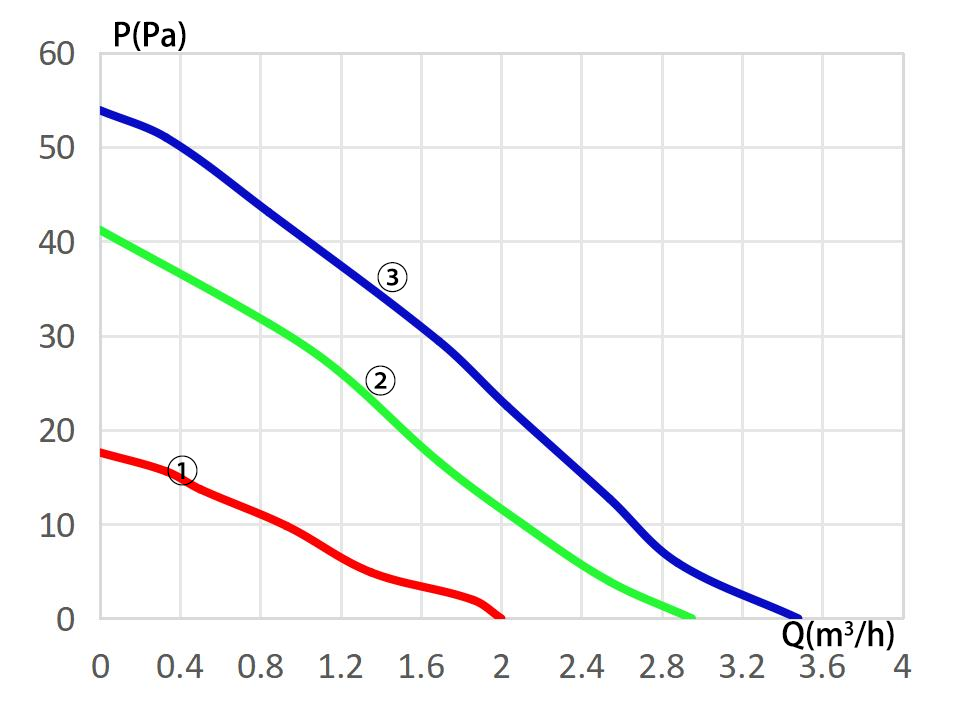
The fan’s actual operating point is determined by the relationship between airflow and static pressure.
This is why professional fan selection should consider the complete P-Q curve, rather than looking at the maximum airflow value alone.
For control cabinet cooling, for example, a fan with slightly lower free-air airflow but better pressure capability may perform better than a high-CFM fan that cannot overcome the system resistance.
3. Axial Fan or Blower Fan?
Different thermal management applications require different airflow solutions.
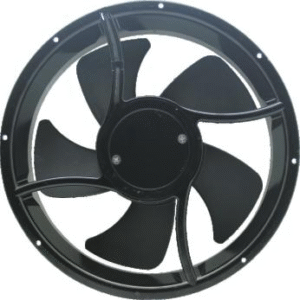
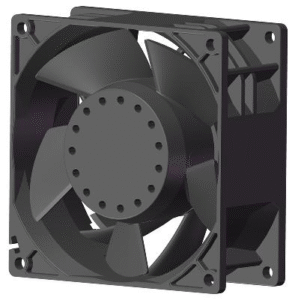
Axial Fans
An axial fan moves air approximately parallel to the fan shaft.
They are commonly used where:
- High airflow is required
- Space is limited
- The airflow path is relatively direct
- Compact installation is important
Typical applications include:
- Electronics cooling
- HVAC systems
- Control cabinet cooling
- Marine ventilation
- Radar cooling
- Industrial ventilation
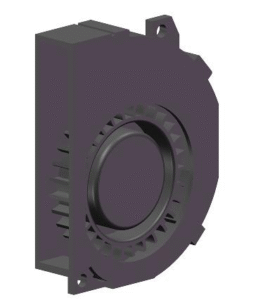
Blower Fans
Blowers are generally more suitable when the system requires higher static pressure or a more controlled airflow path.
They may be preferred for:
- Narrow air channels
- Dense electronic assemblies
- Ducted cooling
- Heat exchanger applications
- Equipment with significant airflow resistance
The correct choice depends on the system rather than simply the fan type.
For this reason, an experienced OEM fan supplier should evaluate the complete airflow path before recommending a model.
4. DC Fan, AC Fan, or EC Fan?
Power supply and control requirements are also important.
DC Axial Fans
DC fans are widely used in electronic equipment because they can provide:
- Compact designs
- Efficient operation
- Flexible voltage options
- Speed-control capability
- Easy integration with electronic control systems
They are particularly suitable for battery-powered equipment, communication systems, industrial electronics, and defense-related equipment.
AC Axial Fans
AC fans remain widely used in industrial ventilation and equipment where AC power is readily available.
They can be appropriate for:
- Industrial ventilation
- HVAC equipment
- Large electrical cabinets
- General-purpose cooling systems
EC Fans
An EC fan combines electronically commutated motor technology with integrated electronic control.
Depending on the application, EC technology can provide:
- Efficient operation
- Variable-speed control
- Reduced energy consumption
- Flexible system control
- Good performance over a wide operating range
For large-scale HVAC cooling and industrial ventilation applications, EC fans can be particularly attractive where energy efficiency and speed control are important.
However, EC is not automatically the best choice for every application. Voltage, control architecture, environmental requirements, airflow, pressure, noise, and lifecycle requirements should all be considered.
5. Consider the Operating Environment
A fan operating inside a clean indoor electrical cabinet has very different requirements from a fan installed on a ship, near a coastal installation, or in an outdoor industrial enclosure.
Temperature
High ambient temperature can affect:
- Motor winding temperature
- Bearing life
- Electronic components
- Lubrication
- Overall reliability
For applications exposed to extreme temperatures, the fan should be evaluated under the actual operating conditions rather than only under room-temperature specifications.
Dust and Water
Outdoor equipment may be exposed to:
- Dust
- Rain
- Humidity
- Condensation
- Salt mist
Appropriate sealing, coating, bearing selection, and structural design can become important factors.
Vibration and Shock
For marine ventilation, naval systems cooling, radar cooling, and airborne electronics cooling, vibration and shock requirements may be significantly more demanding than those of ordinary industrial equipment.
In these applications, fan selection should include consideration of mechanical structure, balancing, bearing performance, mounting method, and environmental testing.
6. Reliability Matters More in Mission-Critical Cooling
For ordinary commercial equipment, a fan failure may be an inconvenience.
For mission-critical equipment, it can become a system-level problem.
Applications such as radar systems, communication equipment, marine electronics, airborne equipment, and defense systems may operate for long periods with limited opportunities for maintenance.
This is where a high reliability cooling system becomes important.
A reliable fan solution should consider more than an advertised MTBF value.
Engineers should also evaluate:
- Bearing technology
- Motor design
- Electronic protection
- Manufacturing consistency
- Dynamic balancing
- Environmental testing
- Quality control
- Traceability
- Long-term product availability
A longer service life is valuable only when the underlying design and manufacturing processes support it.
7. Intelligent Speed Control Can Improve System Performance
A fan does not always need to operate at maximum speed.
If the equipment load changes during operation, variable-speed control can adjust airflow according to the actual thermal requirement.
Depending on the fan design, control methods may include:
- PWM control
- 0–10 V control
- Temperature-based control
- Tachometer feedback
- Alarm output
This can provide several benefits:
- Lower energy consumption
- Reduced acoustic noise
- Reduced mechanical stress
- Better temperature control
- Potentially longer service life
For industrial and mission-critical systems, intelligent fan control can therefore become an important part of the overall thermal management solution.
8. What Should OEM Buyers Ask a Fan Supplier?
When evaluating an OEM cooling solution, purchasing teams and engineers should look beyond the unit price.
Here are several practical questions to ask:
Performance
- What is the free-air airflow?
- What is the maximum static pressure?
- Is a complete P-Q curve available?
- What is the expected operating point in the actual system?
Electrical
- What voltage range is supported?
- Is PWM or analogue speed control available?
- Is tachometer feedback available?
- What protection functions are included?
Environment
- What operating temperature range is supported?
- What ingress protection level is available?
- Has the fan been tested for humidity, vibration, or salt spray where required?
Reliability
- What bearing technology is used?
- How is fan balancing controlled?
- What reliability data is available?
- How is production consistency maintained?
Customisation
- Can the frame, connector, cable, impeller, or control parameters be customised?
- Are OEM and ODM projects supported?
- Can prototypes be provided before mass production?
These questions can help buyers distinguish between a standard commercial fan and a supplier capable of supporting a demanding industrial application.
9. Why Work With SenharFans?
SenharFans focuses on thermal management products for industrial and demanding electronic applications.
Our product portfolio includes:
- DC Axial Flow Fans
- DC Condensing Fans
- DC Blower Fans
- AC Axial Flow Fans
Our products are designed for applications including:
- HVAC systems
- Control cabinet cooling
- Radar cooling
- Marine ventilation
- Naval systems cooling
- Airborne electronics cooling
- Industrial equipment cooling
As an experienced manufacturer, we understand that OEM customers often require more than a standard catalogue product.
Different equipment may require different:
- Airflow performance
- Static pressure
- Voltage
- Dimensions
- Connectors
- Control functions
- Environmental protection
- Noise levels
- Mechanical interfaces
SenharFans supports OEM/ODM development for customers with specific application requirements.
Our engineering capabilities include fan design, performance testing, airflow analysis, prototype development, and production support.
For projects requiring customised thermal management, we can work with customers from initial requirements through prototype evaluation and production.
10. A Better Way to Select an Industrial Cooling Fan
The best fan is not necessarily the one with the highest CFM.
It is the fan that provides the required airflow at the actual system resistance, while meeting the electrical, environmental, mechanical, acoustic, reliability, and lifecycle requirements of the application.
For this reason, fan selection should be approached as a system engineering task.
Whether you are developing an HVAC system, an outdoor control cabinet, radar equipment, marine electronics, or airborne equipment, the right industrial airflow solution can make a significant difference to overall system reliability.
Conclusion
Selecting an axial fan for industrial equipment requires more than comparing catalogue airflow and price.
The actual application environment, heat load, system resistance, power supply, control requirements, temperature, humidity, vibration, and expected service life all need to be considered.
For standard industrial applications, a well-designed DC or AC axial fan may provide an effective solution. For applications requiring variable-speed control and energy efficiency, an EC fan may be appropriate. For high-pressure or specialised airflow paths, a blower fan may offer better system performance.
For mission-critical cooling, however, reliability and application engineering become even more important.
SenharFans works with OEM manufacturers, distributors, system integrators, and equipment developers to provide practical thermal management solutions for demanding applications.
Looking for a reliable OEM fan supplier for your next project?
Send us your required airflow, static pressure, operating temperature, voltage, dimensions, and application environment.
Our engineering team can help evaluate the requirements and recommend a suitable axial fan, cooling fan, ventilation fan, or customised OEM cooling solution.
Contact SenharFans
📧 sales@senharfans.com
🌐 https://senharfans.com/
Let us work with you to build a cooling solution based on real application requirements—not simply catalogue numbers.