Axial Fan vs. Centrifugal Fan: Which Cooling Solution Is Right for Your Industrial Application?
Introduction
Selecting the right cooling fan is one of the most important decisions in thermal management design.
Whether you’re developing industrial automation equipment, HVAC systems, radar electronics, marine control cabinets, or airborne systems, airflow directly influences equipment reliability, operating efficiency, and product lifespan.
One of the most common questions engineers and purchasing teams ask is:
Should I use an axial fan or a centrifugal fan?
Although both move air, they are designed for different operating conditions. Understanding their strengths and limitations helps improve cooling performance while avoiding unnecessary energy consumption or system redesign.
This guide explains the differences between axial fans and centrifugal fans, where each performs best, and how to select the right solution for your application.
Understanding How Each Fan Works
Axial Fans
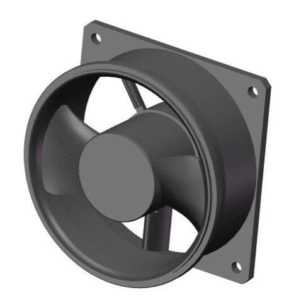
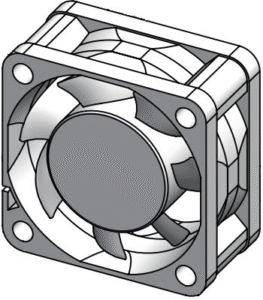
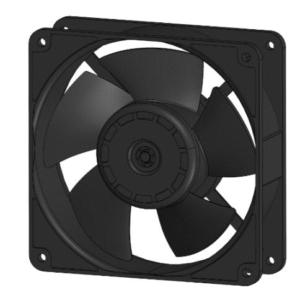
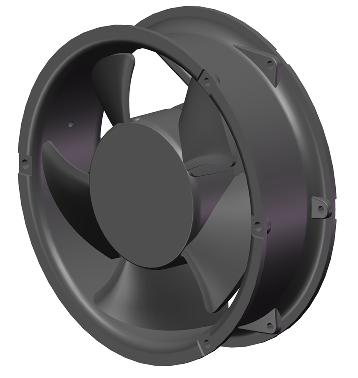
An axial fan moves air parallel to the motor shaft. Air enters and exits in the same direction, allowing the fan to move large volumes of air efficiently.
Axial fans are widely used because they offer:
- High airflow
- Compact structure
- Lower power consumption
- Simple installation
- Cost-effective cooling
These characteristics make axial fans suitable for applications where airflow resistance is relatively low.
Typical applications include:
- HVAC systems
- Electronic equipment
- Server racks
- Industrial control cabinets
- Radar equipment
- Marine electronics
- Airborne electronic cooling
Centrifugal Fans
A centrifugal fan, sometimes called a blower, draws air into the center of the impeller and discharges it at a 90-degree angle.
Compared with axial fans, centrifugal fans generally produce higher static pressure, making them suitable for airflow paths with greater resistance.
They are commonly used in:
- Air duct systems
- Air purification equipment
- Filter systems
- Compact electronic assemblies
- Medical equipment
- Precision ventilation systems
Airflow vs. Static Pressure
One of the biggest differences between the two fan types is how they handle airflow resistance.
An axial fan typically provides higher airflow under low-resistance conditions.
As airflow resistance increases due to filters, heat sinks, or narrow airflow channels, airflow may decrease significantly.
Centrifugal fans are designed to maintain airflow more effectively under higher static pressure conditions.
For engineers, this means that fan selection should always consider the entire airflow path—not just the free-air airflow specification.
Comparing Axial and Centrifugal Fans
| Feature | Axial Fan | Centrifugal Fan |
|---|---|---|
| Airflow Volume | High | Moderate |
| Static Pressure | Moderate | High |
| Installation | Simple | More flexible for ducting |
| Energy Efficiency | Excellent in open airflow | Better in restrictive systems |
| Typical Noise | Lower | Depends on operating conditions |
| Common Applications | Electronics, HVAC, marine, radar | Duct systems, filters, compact enclosures |
Rather than asking which fan is “better,” the more useful question is:
Which fan is better for your specific application?
Typical Industrial Applications
HVAC Systems
Most HVAC equipment uses axial fans for condenser cooling, evaporators, and ventilation because of their efficient airflow and compact design.
However, blower-style centrifugal fans are often selected for indoor air handling units that require airflow through ductwork.
Control Cabinet Cooling
Industrial control cabinets frequently rely on axial fans because they provide efficient airflow across electronic components while keeping installation simple.
Where dense filters or complex airflow paths are present, engineers may choose centrifugal fans to maintain cooling performance.
Radar Cooling
Radar electronics generate substantial heat during continuous operation.
Depending on enclosure layout, designers may combine axial fans for overall airflow with centrifugal blowers for localized cooling of critical modules.
Marine Ventilation
Marine electronics must operate reliably despite humidity, vibration, and limited installation space.
Both fan types can be used, depending on enclosure design and airflow requirements.
Airborne Electronics Cooling
Aircraft and UAV systems often have strict limitations on weight and available installation space.
Compact axial fans are widely used where efficient airflow and lightweight construction are priorities, while centrifugal blowers may be selected for confined airflow channels.
Other Factors to Consider
Beyond airflow performance, engineers should evaluate:
- Operating temperature range
- Environmental protection requirements
- Dust and humidity exposure
- Noise limitations
- Power consumption
- Speed control options
- Expected service life
- Maintenance accessibility
These factors often have a greater impact on long-term system reliability than airflow ratings alone.
How SenharFans Supports OEM Customers
At SenharFans, we understand that every cooling application is different.
Rather than recommending a standard product for every project, we work closely with OEM manufacturers and system integrators to identify the most suitable thermal management solution.
Our product portfolio includes:
- DC axial fans
- AC axial fans
- DC centrifugal blowers
- EC fan solutions
These products are used in:
- Industrial automation
- HVAC systems
- Control cabinet cooling
- Radar systems
- Marine ventilation
- Airborne electronics
- Defense equipment
We also provide OEM and ODM customization, including voltage options, control interfaces, connector configurations, protective coatings, and application-specific performance optimization.
Why Work With SenharFans?
SenharFans is the international brand of Jiangsu Shenghang Electronic Technology Co., Ltd., specializing in high-reliability thermal management solutions.
Our engineering and manufacturing capabilities include:
- Customized fan design
- Airflow testing and verification
- Environmental testing
- Vibration testing
- Salt spray testing
- High- and low-temperature testing
- Quality management based on GJB9001C standards
By combining engineering support with flexible manufacturing, we help customers develop cooling systems designed for long-term reliability.
Conclusion
Choosing between an axial fan and a centrifugal fan is not simply a matter of airflow specifications.
The correct choice depends on your equipment design, airflow resistance, installation constraints, and environmental conditions.
Understanding these differences early in the design process helps improve cooling performance, reduce maintenance requirements, and extend equipment service life.
Whether your project involves industrial automation, HVAC systems, marine electronics, radar cooling, or airborne equipment, selecting the appropriate cooling solution is an important step toward building a reliable thermal management system.
Contact SenharFans
Looking for a reliable OEM fan supplier or expert support for your next thermal management project?
The SenharFans engineering team is ready to help you select the right cooling solution for your application.
SenharFans – Thermal Management Solutions for Mission-Critical Applications