Cooling Fan Noise: How to Interpret dBA Ratings and Balance Noise with Cooling Performance
When selecting a cooling fan for industrial equipment or electronic systems, engineers often focus on airflow, static pressure, voltage, and dimensions. However, noise level is another important parameter that can influence equipment design and user experience.
For communication equipment, control systems, laboratory instruments, indoor electrical enclosures, and other noise-sensitive applications, selecting a suitable cooling fan requires balancing thermal performance with acoustic requirements.
Fan noise is commonly expressed in dBA, but understanding this value requires more than simply comparing numbers in a product specification.
This guide explains what dBA means, where cooling fan noise comes from, which factors influence acoustic performance, and how engineers can evaluate noise when selecting an industrial cooling fan.

1. What Does dBA Mean in Cooling Fan Specifications?
Cooling fan noise is commonly measured and expressed in decibels with A-weighting, written as dBA.
The A-weighting scale adjusts sound measurements to reflect the sensitivity of human hearing at different frequencies. It is widely used when describing environmental and equipment noise.
For engineers and equipment buyers, a fan’s dBA rating provides a useful reference for acoustic comparison.
However, the number should not be interpreted without considering the measurement conditions.
Noise measurements can be influenced by:
- Measurement distance
- Microphone position
- Background noise
- Test room acoustics
- Fan speed
- Airflow restrictions
- Fan installation and mounting conditions
Two fans should ideally be compared using data measured under equivalent conditions.
A lower published dBA value does not automatically mean that a fan will produce less noise in every installation.
2. Where Does Cooling Fan Noise Come From?
Cooling fan noise can originate from several sources. Understanding these sources helps engineers identify possible improvements during equipment design.
Aerodynamic Noise
Aerodynamic noise is generated by the movement of air around the impeller and through the surrounding structure.
It can be influenced by:
- Blade geometry
- Fan rotational speed
- Airflow velocity
- Turbulence
- Inlet and outlet obstructions
- Grilles and protective structures
Poor airflow conditions or turbulent flow around the fan can increase aerodynamic noise.
Motor and Electromagnetic Noise
The motor and its electrical drive system can also contribute to operating noise.
Depending on the motor design and control method, electromagnetic forces and motor operation may produce audible tones or other acoustic components.
Bearing and Mechanical Noise
Mechanical noise may come from bearings, shaft movement, rotor imbalance, or other mechanical interactions.
Bearing condition, assembly quality, lubrication, and mechanical tolerances can all influence the noise generated during operation.
Structural Resonance
A fan does not operate independently of the equipment in which it is installed.
Vibration can be transmitted through the mounting structure and may excite resonant frequencies in the enclosure, panels, or supporting components.
As a result, the complete equipment assembly can produce more noticeable noise than the fan alone.
3. How Fan Speed Affects Noise
Rotational speed is an important factor in cooling fan acoustic performance.
In general, increasing fan speed can increase airflow and pressure capability, but it may also increase aerodynamic and mechanical noise.
However, the relationship between speed and noise is not identical for every fan design.
Blade geometry, motor characteristics, bearing structure, airflow resistance, and installation conditions all influence the final acoustic result.
When comparing different operating speeds, engineers should review both the fan’s cooling performance and its noise data.
A fan operating at maximum speed may provide more cooling capacity than the equipment requires. If the application allows speed adjustment, operating the fan at an appropriate lower speed may help reduce unnecessary noise and power consumption.
The final speed should still maintain the required cooling performance under the actual operating conditions.
4. Why Maximum Airflow and Noise Should Be Evaluated Together
A cooling fan with a high airflow rating is not necessarily the best choice for every application.
The fan must provide sufficient airflow to remove heat, but excessive airflow may increase acoustic output and power consumption without delivering a meaningful benefit to the equipment.
Engineers should therefore consider:
- Required airflow
- Static pressure at the operating point
- Fan speed
- Noise level
- Power consumption
- Equipment temperature limits
For systems with restrictive airflow paths, the fan may need to operate at a higher speed to overcome system resistance.
This can affect both acoustic performance and energy consumption.
The objective should be to achieve the required thermal performance without selecting an unnecessarily aggressive operating condition.
5. How Installation Conditions Influence Fan Noise
Even when a fan has a well-documented noise specification, the final noise level can change after installation.
Several design factors deserve attention.
Inlet and Outlet Clearance
Insufficient clearance near the fan inlet or outlet can disturb airflow and increase turbulence.
Engineers should follow the manufacturer’s installation recommendations and avoid unnecessary obstructions near the impeller.
Protective Grilles and Filters
Grilles, filters, and other protective structures can change the airflow pattern.
Depending on their design and position, they may introduce additional resistance or turbulence, affecting both fan performance and noise.
Mounting Structure
A rigid or poorly designed mounting arrangement may transmit vibration into the equipment enclosure.
Appropriate mounting design and vibration isolation, where suitable, can help reduce structure-borne noise.
Airflow Path Design
Sharp turns, narrow passages, abrupt changes in cross-section, and poorly arranged internal components can create turbulence.
Improving the airflow path may help reduce unnecessary acoustic disturbance while maintaining effective cooling.
6. How to Compare Cooling Fan Noise Specifications
When evaluating different fan models, engineers should not compare dBA values in isolation.
A useful comparison should include the operating conditions and other technical parameters.
| Parameter | What to Check |
|---|---|
| Noise level | Published dBA value and measurement conditions |
| Speed | Rated rotational speed in RPM |
| Airflow | Air volume delivered by the fan |
| Static pressure | Pressure capability under system resistance |
| Power | Electrical power consumption |
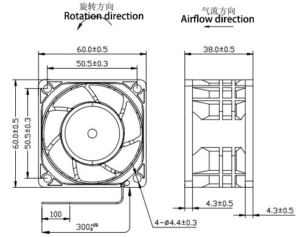
| Dimensions | Fan size and installation arrangement |
| Operating conditions | Temperature and environmental requirements |
It is also important to distinguish between sound pressure level and sound power level.
Sound pressure level describes the sound measured at a particular position and is affected by the surrounding acoustic environment.
Sound power level describes the total acoustic energy emitted by a source and is less dependent on the measurement location.
A specification expressed in dBA should therefore be interpreted according to the measurement method used by the manufacturer.
When comparing suppliers, ask whether their published noise figures were obtained under equivalent test conditions.
7. Choosing a Low-Noise Fan Without Compromising Cooling
In noise-sensitive equipment, selecting a quieter fan should not come at the expense of necessary thermal performance.
A practical selection process includes the following steps.
Step 1: Establish the thermal requirement
Determine the heat generated by the equipment and the acceptable operating temperature.
Step 2: Identify the required operating airflow
Estimate the airflow needed to remove heat under the expected operating conditions.
Step 3: Evaluate system resistance
Consider filters, grilles, heat sinks, ducts, and other restrictions that affect installed airflow.
Step 4: Compare fan performance data
Review airflow, static pressure, rotational speed, power consumption, and noise together.
Step 5: Evaluate installation conditions
Check inlet and outlet clearance, mounting structure, vibration transmission, and airflow distribution.
Step 6: Validate the complete equipment
Where acoustic performance is important, measure noise on the assembled equipment under representative operating conditions.
This final step is important because the acoustic behavior of an installed cooling system may differ from the fan’s individual test result.
8. AC Axial Fans, DC Axial Fans, and Blowers: Acoustic Considerations
Different fan types serve different cooling requirements.
AC Axial Fans
AC axial fans are used in equipment designed around an AC power supply.
When selecting an AC fan, engineers should consider its rated frequency, rotational speed, airflow, pressure capability, and published noise data.
DC Axial Fans
DC axial fans are widely used in electronic equipment and systems with DC power supplies.
Depending on the model, speed-control functions may be available. Where supported by the fan and host system, speed adjustment can help balance cooling demand, power consumption, and acoustic performance.
DC Blowers
DC blowers provide a more directed airflow path and may be considered for equipment with concentrated cooling requirements or restricted ventilation passages.
Their acoustic performance should be evaluated under the intended operating condition, rather than assuming that a blower is automatically quieter or noisier than an axial fan.
The appropriate fan type depends on the equipment layout, thermal requirements, airflow path, and acoustic limits.
9. What OEM Engineers Should Ask Their Fan Supplier
When selecting a cooling fan for an OEM project, engineers should request enough information to evaluate both cooling and acoustic performance.
Useful technical information includes:
- Rated noise level and measurement conditions
- Rated speed and available speed options
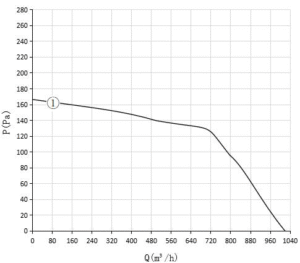
- Airflow and static-pressure performance curves
- Rated voltage and operating voltage range
- Power consumption
- Bearing structure
- Mechanical dimensions and mounting details
- Available speed-control or monitoring functions
- Operating temperature range
If noise is a critical project requirement, communicate the target acoustic limit and the intended measurement conditions to the supplier.
This helps ensure that the fan is evaluated against the actual equipment requirements rather than an isolated catalogue figure.
10. Cooling Fan Solutions from SenharFans
SenharFans, the cooling fan brand of Jiangsu Shenghang Electronic Technology Co., Ltd., provides AC axial fans, DC axial fans, and DC blower solutions for industrial and electronic cooling applications.
The company’s products are developed and manufactured under its GJB9001C-2017 quality management system. The company also holds a Level-II confidentiality qualification.
For OEM and equipment development projects, fan evaluation can consider airflow, static pressure, rotational speed, noise, power consumption, dimensions, electrical requirements, and the intended operating environment.
The company’s testing capabilities include airflow, acoustic, salt-spray, high- and low-temperature, damp-heat, thermal-shock, and vibration testing.
For noise-sensitive applications, customers should identify the required acoustic limits and operating conditions at the beginning of the project. This allows the fan and the complete equipment design to be evaluated against the same requirements.
Conclusion: Balance Acoustic Performance with Cooling Requirements
Cooling fan noise is an important consideration in industrial and electronic equipment design.
A dBA rating provides a useful reference, but it should always be interpreted alongside measurement conditions, fan speed, airflow, static pressure, and installation design.
The best cooling fan is not necessarily the one with the lowest published noise value. It is the fan that delivers the required cooling performance while meeting the equipment’s acoustic, electrical, mechanical, and environmental requirements.
If you are developing industrial or electronic equipment and need assistance evaluating AC axial fans, DC axial fans, or DC blower solutions, contact the SenharFans team.
Jiangsu Shenghang Electronic Technology Co., Ltd.
Email: sales@senharfans.com
Phone / WeChat / WhatsApp: +86-138-1239-0890
Website: https://senharfans.com/
Contact us with your fan specifications, target noise level, cooling requirements, and installation details for technical assistance.